No More Whining: painted workbook cover of a fictional Singapore family, with real practical-sheet pages behind it.

Self-paced course

No More Whining

Keep a Fair Answer When the Asking Starts Again

Check what your child needs, then choose a clear yes, no or wait. Practise words you can repeat and clearer asking when everyone is calm.

One payment · Usual price S$14.90 now S$12.90 MEMBERS’ PRICE · usual price S$14.90

Buy the repeated-asking course · S$12.90Read the free needs-check lesson

Who This Is For

Parents, grandparents and helpers of children aged 2 to 10 who are worn down by repeated asking and want an answer they can stick with.

This is for repeated asking and everyday whining; No More Tantrums focuses on the first moves during a big meltdown.

Answer the Need and Keep the Limit Clear

Check hunger, tiredness or needing help. Then practise a clear answer and a better way to ask at a calm time.

Spot the Need, Hold the No, Teach Clearer Asking

  • You can separate a real need from a request whose answer is still no.
  • You have words to repeat calmly without reopening the whole decision.
  • You can teach one clearer request and plan what to do when your patience runs low.

Need or Whine? Hard to Tell by Dinnertime

  • You’ve said no three times. Now you’re tempted to say yes for some quiet.
  • You can’t tell whether your child needs help or wants a different answer.
  • By dinner, even a small request comes out in a whine and you’re close to snapping.

What Your Payment Includes

  • 9 short lessons, 62 minutes in all, to read at your own pace
  • 9 what-to-say cards to practise before you need the words
  • 9 practice situations with feedback on the response you choose
  • 18 quick checks so you can check your understanding, with answers explained
  • Checklists and notes saved on the device you use
  • 1 page of printable practice sheets included
  • A completion certificate you can print

Yes, No or Wait, Plus a Calm-Time Asking Game

  • Check hunger, tiredness and the need for help before deciding how to answer.
  • Use yes, no and wait lines, including what to say after the same request comes again.
  • Practise “help, please” and feeling words through a calm-time game.
  • Offer real small choices and a clear heads-up for shoes, clean-up and leaving the playground.
  • Plan a little time together, and notice clearer asking when it happens.
  • Use the included context-and-response log to spot patterns, with a final lesson on pausing and repair.

A Look Inside the Course

9 lessons, 62 minutes in all. Start with the part you need and work at your own pace.

  1. What's Behind the Whine

    Check what your child needs before you answer the whine

    8 min · Free to read

  2. A Little Attention, at a Time You Choose

    Set up a short, regular moment of attention that fits your day

    7 min · In the course

  3. One Clear Answer: Yes, No or Wait

    Keep a fair limit without repeating yourself or giving in

    7 min · In the course

  4. Teach "help, please" and Feeling Words

    Practise a better way to ask when everyone is calm

    7 min · In the course

  5. Real Small Choices

    Offer a genuine choice that still gets the job done

    7 min · In the course

  6. Notice When They Ask Well

    Point out good asking in a specific way, without grading your child

    6 min · In the course

  7. Heads-Ups for Endings

    Give a clear cue before something ends, then follow through kindly

    7 min · In the course

  8. Light Play for Chores and Clean-Up

    Use a little play to get moving, without making fun of the feeling

    6 min · In the course

  9. When You're About to Snap

    Pause safely, repair after you snap, and keep your plan going

    7 min · In the course

Get the remaining 8 lessons on repeated asking →

Try a full lesson free

Lesson 1 of 9 · 8 min

What's Behind the Whine

Goal: Check what your child needs before you answer the whine

It's 6.45pm in your HDB kitchen. The rice is on, you're still replying to a work message, and your five-year-old is pulling at your sleeve: "Mummyyy, I want something. I want something." Your shoulders go up. You just want the noise to stop.

This lesson gives you a quick check to do first, and the words to use next.

The sound is a message. A whiny voice can mean your child is hungry, tired, uncomfortable, stuck or wanting you nearby. The voice alone doesn't tell you which. So look at what happened just before. Did they skip the snack? Was it a long day at childcare? Did the puzzle just fall apart?

Sort out the real need first. Teach the better voice after.

Your Five-Step Response

  1. Pause. Take one breath and move close enough to hear properly.
  2. Check the body. Pain, feeling unwell, hungry, tired, too much noise?
  3. Meet the need. Water, a snack or a hand with the puzzle, if you can.
  4. Show the words once. If your child is able, model a simple ask: "Help, please."
  5. Answer clearly. Yes, no, or a real wait: "After I drain the rice."

What to say

Before Dinner

Say

  • You sound upset. Are you hungry, or do you need help?
  • Here's some cut fruit while dinner cooks.
  • Next time you can say, or show me, 'Help, please.'

Avoid

  • Stop that horrible noise.
  • I'm not helping until you ask nicely.

Look for the pattern. At a hawker centre, the whine may come after a long queue and a lot of noise. At home, it may start just as you sit down to finish some work. These are clues. They aren't proof that anyone did something wrong.

Then make one small change you control: a quieter seat, a snack before the queue, or a few minutes to help start an activity before your call.

What would you do?

Your tired four-year-old asks for water in a long, whiny voice. You've had a long day too. What do you do?

  • Give the water, then show her the words: "Water, please"

    Water is basic care, so it doesn't depend on the voice. Once she's had a drink, one quick model of the words teaches more than a lecture.

  • Say "Ask me nicely first" and wait

    It's a natural reflex, and you do want nicer asking. But a tired, thirsty child usually whines more while she waits. Give the drink first, then show her the words.

  • Tell her to stop whining, then hand over the water

    You still met the need, and that matters most. The telling-off just adds friction when she's already tired. Try naming the need instead: "You're thirsty. Here you go."

Quick check

The whining starts. What do you check first?

Show the answer

Whether something is wrong: safety, hunger, tiredness or needing help

Coaching works better once you know what needs attention. A hungry or tired child isn't ready to learn a new way of asking.

Spot the Pattern This Week

Your ticks stay on this device.

Quick check

You notice the whining is worst on the walk home from childcare. What's the most useful next step?

Show the answer

Plan one change, like a snack and water in the bag for the walk

A pattern helps you choose a practical change. It isn't a score for your child, or for anyone at home.

Your private note

Saved on this device only. We never see it.

What the rest of the course covers

  • Lesson 2: short, regular moments of attention that fit a busy day.
  • Lesson 3: one clear yes, no or wait, and how to stop the debate.
  • Lesson 4: a calm-time game to teach "Help, please" and feeling words.
  • Lesson 5: real small choices that get shoes on without threats.
  • Lesson 6: notice good asking without grading or comparing.
  • Lesson 7: heads-ups that make leaving the playground easier.
  • Lesson 8: light play for clean-up and chores.
  • Lesson 9: what to do when you're about to snap, and how to repair.

Remember

Check the need first. Teach the voice later.

Try This Week

For 3 days, when one regular whine starts, ask "Hungry, tired, or need help?" before you answer.

Sources

Try the checklist or write a note. The lesson player keeps them on this device. Practise “What's Behind the Whine” in the player →

Questions Before You Buy

Read about the lesson format, included sheets, access and refunds before you decide.

Will I be told to ignore my child until they ask nicely?

You check what they need first. The lessons include help, attention and tiredness, then show how to keep a fair answer and practise clearer asking at a calm time.

Do I need to finish it all at once?

No. Read one short lesson at a time on your phone or computer. The lessons total 62 minutes. Take the practice into your day as you go.

Is this a video course?

These are read-at-your-own-pace lessons with scripts, checklists, practice situations and quick checks. Try the full free lesson to see the format before buying.

What printables are included?

Your course includes 1 page of printable practice sheets. The optional Whining Response Script Cards is a separate pack, at S$6.90 with the course or S$7.90 on its own.

How do I get the course after paying?

Sign in or create a free account before paying through Stripe. After payment, open the lessons in My Family Plan. Download any included course sheets there too.

What if it isn’t right for our family?

Email contact@raisingangels.sg within 14 days of buying for a full refund. Your access to that course ends when the refund is made.

How long can I use it?

You have access for as long as RaisingAngels.sg offers the course. You can return to the lessons during that time.
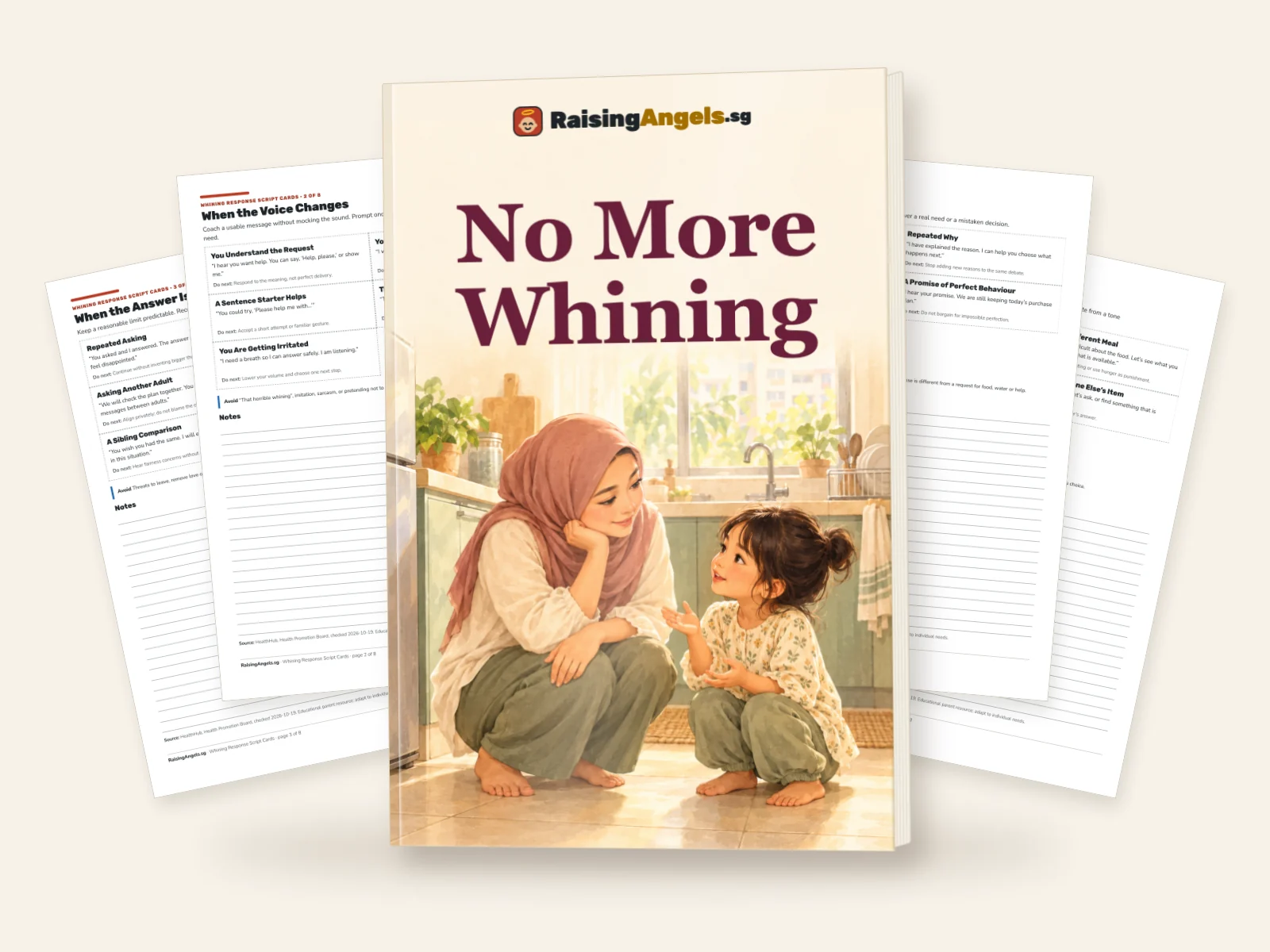
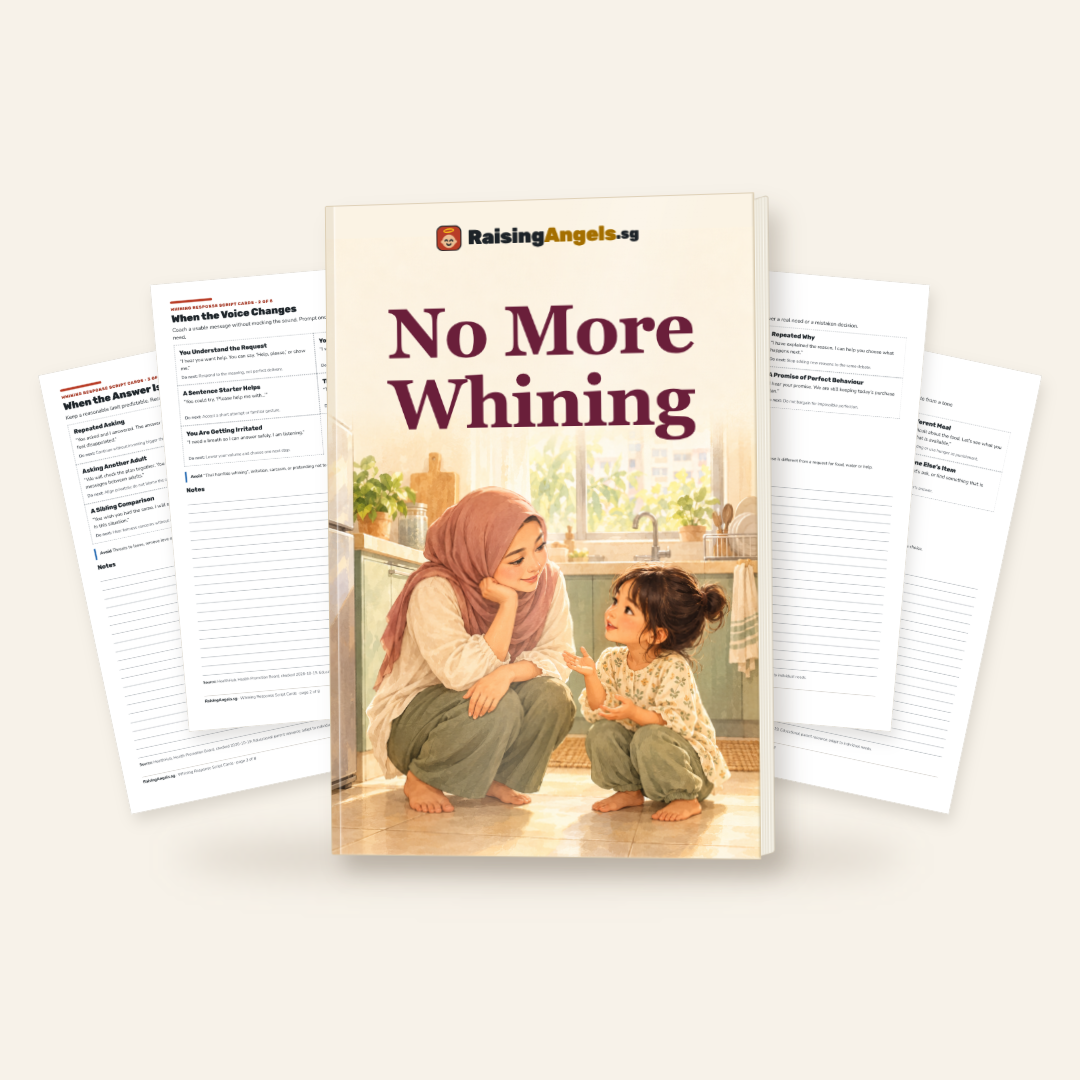
No More Whining: painted workbook cover of a fictional Singapore family, with real practical-sheet pages behind it.

Have Your Answer Ready for Repeated Asking

Usual price S$14.90 now S$12.90 MEMBERS’ PRICE · usual price S$14.90

When your child asks to be carried, check what came before the asking. Use the log to prepare a fair answer for the walk home.

Read all 9 lessons at your own pace on your phone or computer. After payment, open the course in My Family Plan.

You’ll sign in or create a free account, then pay through Stripe. One payment for this course.

Not for you? Full refund within 14 days.

Buying opens soon. Questions? Email contact@raisingangels.sg.

Email contact@raisingangels.sg within 14 days of buying. Your course access ends when the refund is made.

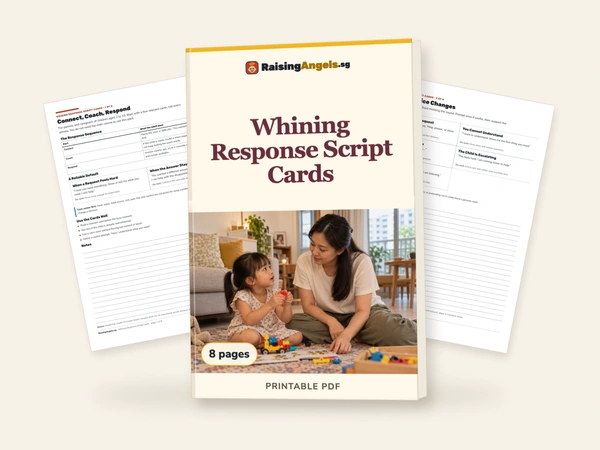
Whining Response Script Cards: printable pack showing its first two real pages; 8 pages.

Prefer the Companion Pack on Its Own?

The Whining Response Script Cards is S$7.90 on its own. This buys the companion pack, without the course lessons.

Not for you? Full refund within 14 days.

Need Help With More Than One Worry?

Choose a bundle below. Each lists the courses it includes and its total price.

Preschool and P1 Bundle

Get 4, Pay for 3

Bought one by one S$51.60 now S$38.70

  • Ready for P1
  • Seven-Day Sleep Reset
  • No More Screen Time
  • No More Whining

Not for you? Full refund within 14 days.

Calmer Home Bundle

Get 4, Pay for 3

Bought one by one S$51.60 now S$38.70

  • No More Yelling
  • No More Whining
  • Respect Without Resentment
  • Sibling Conflict Toolkit

Not for you? Full refund within 14 days.

Everything Bundle

All 16 Courses

Bought one by one S$206.40 now S$99

See the 16 courses
  • Before Baby Arrives
  • When Mistakes Feel Too Big
  • First Phone and Online Safety Family Kit
  • Homework Independence Toolkit
  • No More Screen Time
  • No More Whining
  • No More Yelling
  • Puberty Conversations Made Easier
  • Ready for P1
  • Respect Without Resentment
  • Seven-Day Sleep Reset
  • Sibling Conflict Toolkit
  • Singapore Picky Eating Toolkit
  • Starting Childcare
  • No More Tantrums
  • Toilet Training and Troubleshooting Toolkit

Not for you? Full refund within 14 days.