
Quick answer
A percentile says where one measurement sits among children of the same age and sex in the WHO Child Growth Standards. On the 50th percentile, about half of the children in the reference measure less. It is not a grade and not a target. Your doctor looks at the trend over several visits, and at the whole child, before drawing any conclusion.
The key point: A percentile is a position on a chart, not a score: the trend over visits matters most.
Who is this for?
Parents of children from birth to 5 years who want to understand the numbers from a clinic visit. The calculator uses the WHO Child Growth Standards for weight-for-age, length or height-for-age and head circumference-for-age, for boys and girls.
How do you use the calculator?
- Copy the measurements and the date they were taken from the Child Health Booklet.
- Enter the date of birth, the measurement date, the sex and one or more measurements in the Growth percentile calculator. Nothing you enter leaves your phone.
- Baby born early? Add the original due date as well. The calculator then uses corrected age: your baby’s age counted from the due date, which is age from birth minus the weeks born early. Ask your baby’s doctor which age to use, and for how long. See Born early or twins: bills, grants and leave.
- Read where each measurement sits. Under 2 years the chart uses length lying down; from 2 years it uses standing height.
- Look at more than one visit. One measurement on its own says little.
- Bring your questions and the Child Health Booklet to your next visit, and discuss them with your doctor.
How should you read the result?
The calculator gives each measurement a percentile and a plain description. It may be comfortably in the typical range, or on the smaller or larger side of typical, which is common. Outside the typical range on the chart is worth showing your doctor. None of these is a grade. A child can sit on a low or high percentile and be growing well, and measurements taken at home or with different scales can differ.
Which tool and download help?
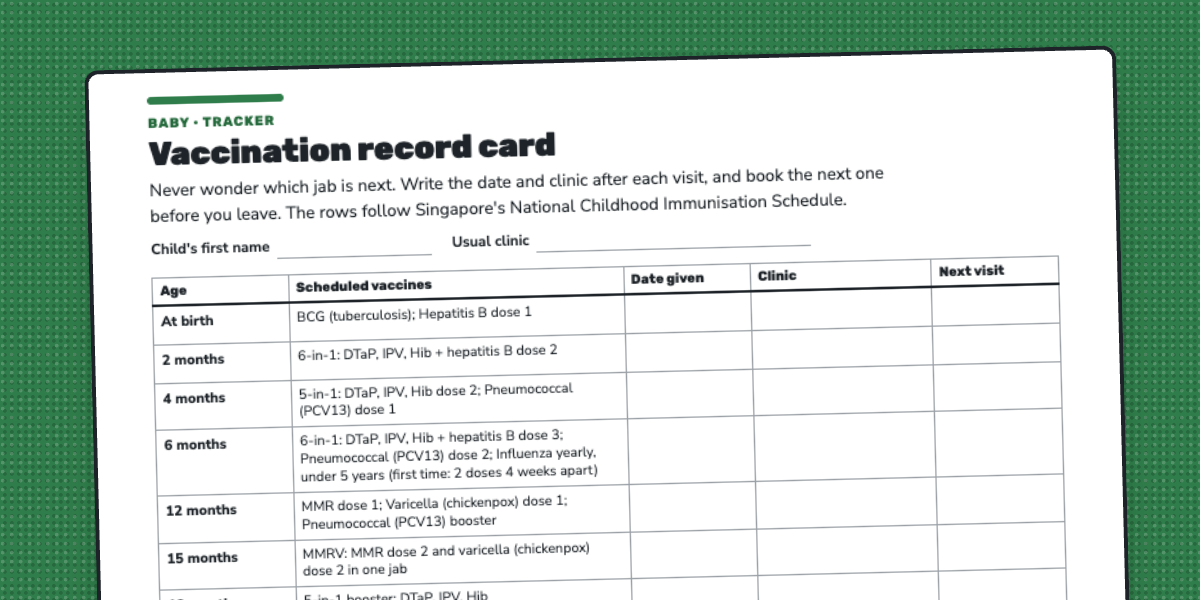
The Growth percentile calculator does the WHO arithmetic and explains it in plain words. Keep the Vaccination record card with the Child Health Booklet so visit dates and questions travel together.
What can a percentile not tell you?
It does not diagnose anything and it does not say whether a child is healthy. It works only from birth to 5 years and only with the measurements you enter. Your doctor reads growth over time together with feeding, development and family history. If you are worried, discuss it with your doctor.
Printables for this guide
Vaccination record card
Every visit on Singapore's National Childhood Immunisation Schedule, from birth to Secondary 2. Write in the date, clinic and next appointment.
Try it with your numbers
Put in your own details to see your answer.
Open growth percentile calculator →Frequently asked questions
What does the 50th percentile mean?
About half of the children of the same age and sex in the WHO reference measure less, and about half measure more. It is not a target. Try the growth percentile calculator with the numbers from your Child Health Booklet.
Is a low percentile bad?
Not by itself. Many children sit on a low or high percentile and grow well. Your doctor looks at the trend over visits and at the whole child.
Which growth chart does the calculator use?
The WHO Child Growth Standards, from birth to 5 years, for weight, length or height, and head circumference. The charts in the Child Health Booklet (December 2025 edition) are Singapore charts from a 2000 National Healthcare Group Polyclinics study. So a percentile here can differ a little from the one your clinic plots.
My baby was born early. Which age does the calculator use?
Add the original due date and it uses corrected age, counted from the due date. Ask your baby’s doctor which age to use for growth, and for how long.
Why is my child’s length measured lying down?
The WHO standards use length lying down under 2 years and standing height from 2 years, so the calculator does the same.
Keep this guide for the next big decision.
Build your own reading list and pick up where you left off with a free RaisingAngels account.
Free account · Tools stay free without an account.
Sources & assumptions
- WHO — Child growth standards ↗
- HealthHub — Parent Hub: Child Health Booklet (updated December 2025) ↗
Not a diagnosis and never a grade.