
Quick answer
Pick your child’s age, tick what you have seen, and the checker lists what you have not seen yet as things to mention at the next check-up. It follows the “most children do this by this age” style of the Child Health Booklet, whose developmental checklists are on pages 5 to 28. It is a conversation guide, not a test, and it never scores your child.
The useful number: Tick 5 of the 8 items at 12 months and you leave with 3 things to mention to your doctor, not a score.
Who is this for?
Parents of children from 4 weeks to 5 years who want to make the most of a developmental check-up. The Child Health Booklet lists 7 screening touchpoints: 4 weeks, 3 or 4 months, 6 months, 12 months, 18 months, 30 months and 48 months. The checker has a list for each of them, plus 9 months, 2, 3 and 5 years.
How do you prepare for the check-up?
- Open the Milestone checker and choose your child’s next check-up, or the age closest to theirs. Premature babies follow their adjusted age.
- Tick what you have seen your child do. Nothing you tick leaves your phone.
- Read the list of things you have not seen yet. These are simply things to mention.
- Add anything else you have noticed, in your own words, and when you noticed it.
- Bring the list and the Child Health Booklet to the check-up and discuss it with your doctor.
What does the result look like?
At 12 months the checker shows 8 things most children do by then, such as pulling up to stand, waving bye-bye and looking for hidden objects. If you have seen 5 of them, the result is 3 things to mention at the next check-up. It does not say whether that is good or bad. Children develop at their own pace, and your doctor looks at the whole child.
Which tool and download help?
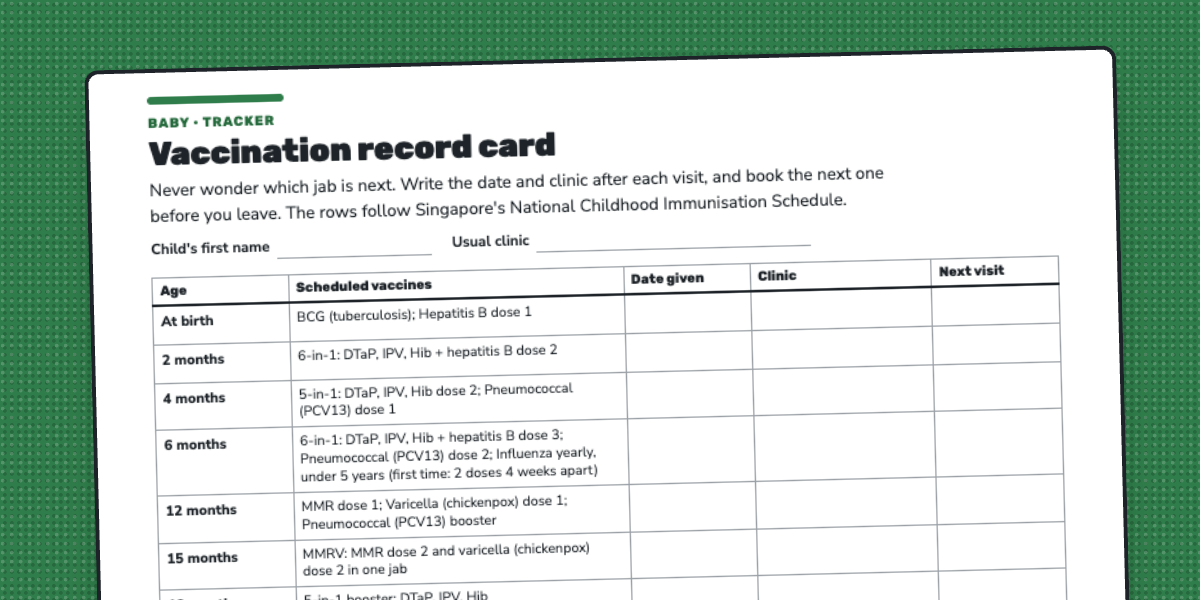
Use the Milestone checker before each check-up. Keep the Vaccination record card with your Child Health Booklet so the visit dates and your notes are in one place.
What can the checker not tell you?
It is not a screening or assessment tool and it does not diagnose anything. The item wording is a simplified list in the style of the Child Health Booklet and the CDC checklists, not the booklet itself. If you have any concern, at any age, discuss it with your doctor without waiting for the next check-up.
Printables for this guide
Vaccination record card
Every visit on Singapore's National Childhood Immunisation Schedule, from birth to Secondary 2. Write in the date, clinic and next appointment.
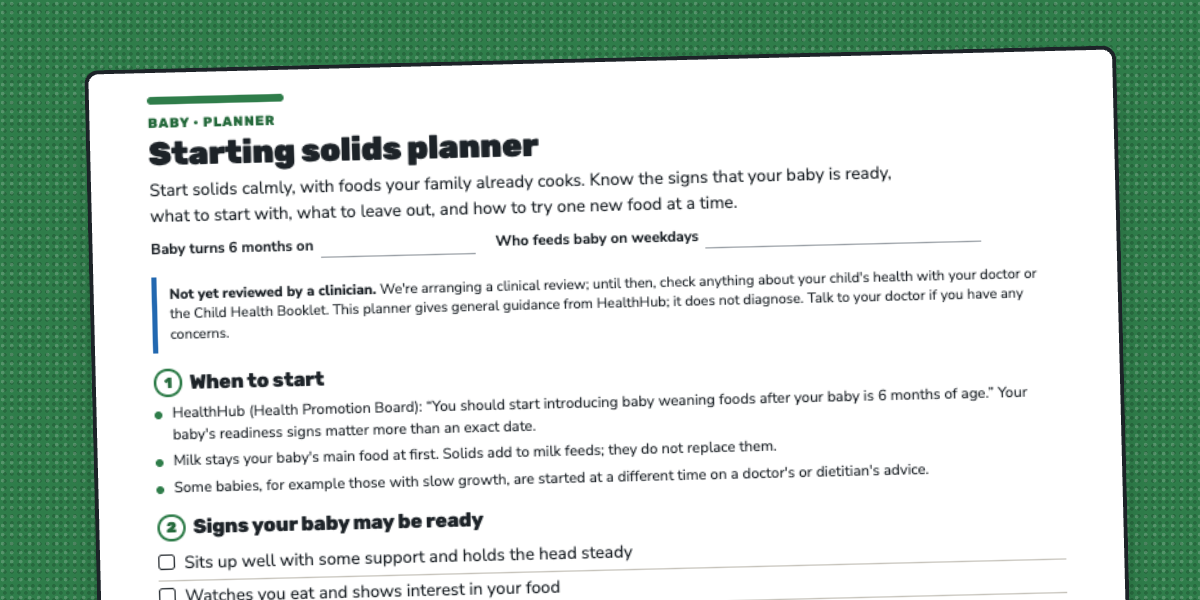
Starting solids planner
HealthHub's timing after 6 months, readiness signs and local first foods like rice porridge and pumpkin. Includes a two-week tracker for every carer.
Frequently asked questions
When are the developmental check-ups in Singapore?
The Child Health Booklet lists 7 screening touchpoints: 4 weeks, 3 or 4 months, 6 months, 12 months, 18 months, 30 months and 48 months.
Does the milestone checker score my child?
No. It lists what you have seen and what to mention at the next check-up. It never grades a child. Try the milestone checker before your visit.
My baby was born early. Which age should I use?
Use your baby’s adjusted age, and check with your doctor which age they are using.
What if I am worried before the next check-up?
Do not wait. Write down what you have noticed and discuss it with your doctor.
Keep this guide for the next big decision.
Build your own reading list and pick up where you left off with a free RaisingAngels account.
Free account · Tools stay free without an account.
Sources & assumptions
A conversation guide, never a score or a diagnosis.