Quick answer
Every Singapore citizen child in a licensed full-day centre gets a Basic Subsidy. For childcare it is S$300 a month if the mother works at least 56 hours a month, or S$150 if not. For infant care it is S$600 or S$150. Working families also get an income-tested Additional Subsidy of up to S$467 for childcare or S$710 for infant care, while household income is S$12,000 or below. From 1 January 2027 the ceiling rises to S$15,000.
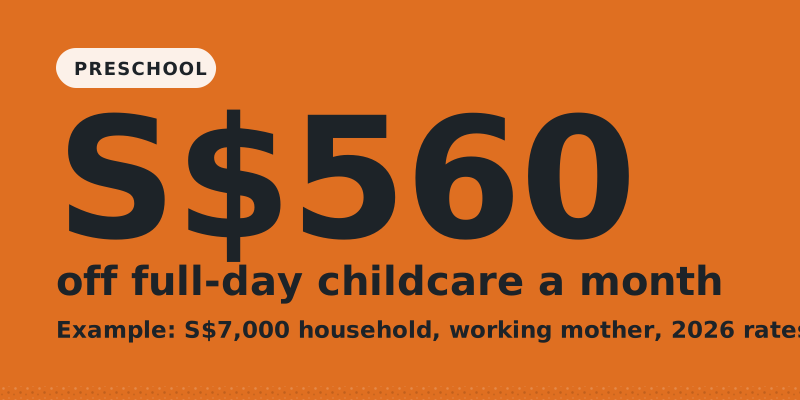
The useful number: A working mother with S$7,000 household income and 3 family members gets S$560 a month off full-day childcare in 2026, and S$640 from 1 January 2027.
ECDA fee caps by operator type, monthly, before GST:
- Anchor Operator centres
- Childcare up to S$610 · infant care up to S$1,235 a month
- Partner Operator centres
- Childcare up to S$650 · infant care up to S$1,290 a month, for Singapore Citizen children
Other centres set their own fees. Subsidies come off these fees.
Who gets the subsidy, and when?
Parents of Singapore citizen children in full-day infant care (2 to 18 months) or childcare (18 months to 6 years) at ECDA-licensed centres. The 2026 table applies until 31 December 2026. The 2027 table applies from 1 January 2027.
How do you work out your subsidy?
- Check your applicant status. The main applicant is the mother, or the single father if divorced, separated or widowed. “Working” means at least 56 hours a month, including part-time and freelance work.
- Add up gross monthly household income: under 5 people, both parents’ pay only (ECDA).
- If 5 or more related members share your registered address, also work out per capita income: the pay of everyone at that address divided by members. ECDA does not say which test it uses when both could apply. The calculator uses the one that gives more.
- Read your band: Basic plus Additional Subsidy, and the minimum co-payment for that band.
- Lower-income non-working families: since 9 December 2024, a childcare (not infant care) family with household income of S$6,000 and below, or per capita income of S$1,500 and below, gets full subsidies. From 1 January 2027 the limits are S$7,500 and S$1,700.
- Take your centre’s fee, subtract the subsidy, and remember the minimum co-payment.
- Apply through your centre or the LifeSG app. Log in to LifeSG’s preschool search to see the fees after subsidy that ECDA estimates for you.
What does a S$7,000 household get?
A working mother, household income of S$7,000, 3 family members, full-day childcare:
- Basic Subsidy
- S$300
- Additional Subsidy, 2026 table
- S$260
- Total off the fee each month, 2026
- S$560
- Minimum co-payment, 2026
- S$104
- Additional Subsidy, 2027 table
- S$340
- Total off the fee each month, from 1 January 2027
- S$640
In infant care, the same family gets S$980 a month in 2026 (S$600 plus S$380), and S$1,100 from 1 January 2027 (S$600 plus S$500).
What did the National Day Rally 2026 announce?
Two further changes were announced on 23 August 2026. Full-day fees at Government-supported centres are to fall to S$150 a month for childcare and S$300 for infant care, before means-testing, with reductions from 2028 and the target levels by 2030. Full subsidies are also to be extended to families with Singapore citizen children whatever the main applicant’s working status.
The Government says implementation details come in early 2027. Until ECDA publishes new tables, the calculator uses the 2026 and 2027 tables above.
Check your numbers and keep a record
The Childcare subsidy calculator shows both years side by side. Write your figures on the Infant and childcare subsidy worksheet before you visit centres.
Next, put your shortlisted centres side by side in the Preschool comparison workbook.
What the calculator leaves out
It covers full-day programmes only. Half-day and flexi-care have their own tables in the same ECDA PDF. ECDA’s subsidies are for Singapore Citizen children, so for a PR or foreign child the calculator shows S$0 and the full fee. Anchor Operator and Partner Operator fee caps are not modelled.
A mother who is not working may get time-limited higher subsidies under ECDA’s Special Approval, for example while looking for a job or pregnant. The calculator does not model it. ECDA’s assessment of income and working status prevails. The site never decides eligibility. Families in financial difficulty can ask ECDA or a Social Service Office about further help.
Printables for this guide
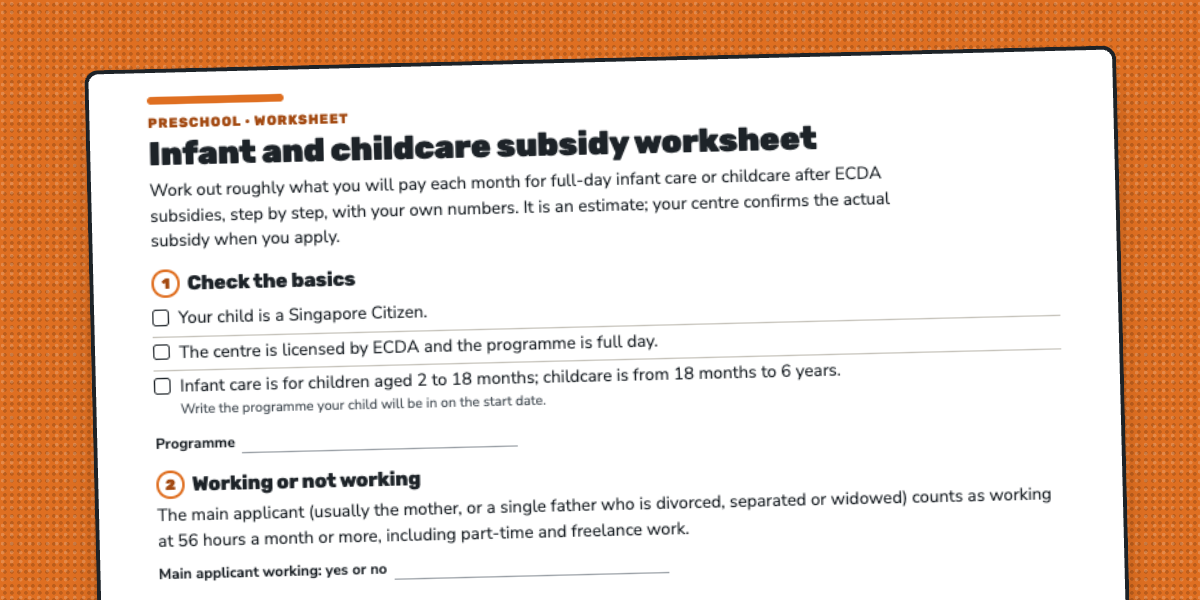
Infant and childcare subsidy worksheet
Work out your monthly full-day infant care or childcare fee after ECDA's basic and additional subsidies. The 2026 and 2027 bands are on one page.
See your own subsidy
Enter your household income, family size and the centre’s fee. See your subsidy for 2026 and 2027, and what you still pay.
Work out your subsidy →Frequently asked questions
How much is the childcare subsidy in Singapore in 2026?
Up to S$767 a month for full-day childcare: S$300 Basic Subsidy plus up to S$467 Additional Subsidy for a working mother. Infant care goes up to S$1,310 (S$600 plus S$710). The Additional Subsidy shrinks as income rises and stops above S$12,000. Try the childcare subsidy calculator.
What changes on 1 January 2027?
The income ceiling rises from S$12,000 to S$15,000, and the per capita ceiling from S$3,000 to S$3,400. The bands widen, so many families get more. Our S$7,000 example goes from S$560 to S$640 a month.
Do I get the Additional Subsidy if I am not working?
Usually not. You get the S$150 Basic Subsidy. The exception is childcare for lower-income families: household income of S$6,000 and below, or per capita income of S$1,500 and below, gets full subsidies. From 1 January 2027 the limits are S$7,500 and S$1,700. Others can apply for ECDA’s time-limited Special Approval, for example while looking for a job.
Will preschool fees fall further after 2027?
Yes, as announced at the National Day Rally 2026: full-day fees at Government-supported centres are to fall to S$150 a month for childcare and S$300 for infant care by 2030, with reductions from 2028. Details come in early 2027, so the calculator does not model them yet.
How does per capita income work for big families?
If 5 or more related members share your registered address, ECDA can also divide household income by members. ECDA does not say which test it uses when both could apply; the calculator uses the one that gives the higher subsidy.
What is the minimum co-payment?
The least you pay each month, however high the subsidy. In 2026 it ranges from S$3 to S$315 for childcare and S$40 to S$700 for infant care, depending on your band.
Does my PR child get the subsidy?
No. ECDA’s Basic Subsidy and Additional Subsidy are for Singapore Citizen children, so a PR child pays the centre’s full fee. The calculator shows S$0 with ECDA’s reason.
Keep this guide for the next big decision.
Build your own reading list and pick up where you left off with a free RaisingAngels account.
Free account · Tools stay free without an account.
Sources & assumptions
- ECDA — Subsidy tables for infant care and childcare, 2023 to 2027 (PDF, updated 6 October 2026) ↗
- ECDA — Overview of the infant and childcare subsidy scheme ↗
- LifeSG — Search for preschools (log in to see ECDA’s estimate of your fees after subsidy) ↗
- Made For Families — National Day Rally 2026: Helping Singaporeans Start and Raise Families with Confidence ↗
Full-day programmes and Singapore citizen children only. Fee cuts and full subsidies announced at the National Day Rally 2026 are not modelled until details are published in early 2027. ECDA’s assessment prevails; LifeSG’s preschool search shows ECDA’s own estimate once you log in.