Quick answer
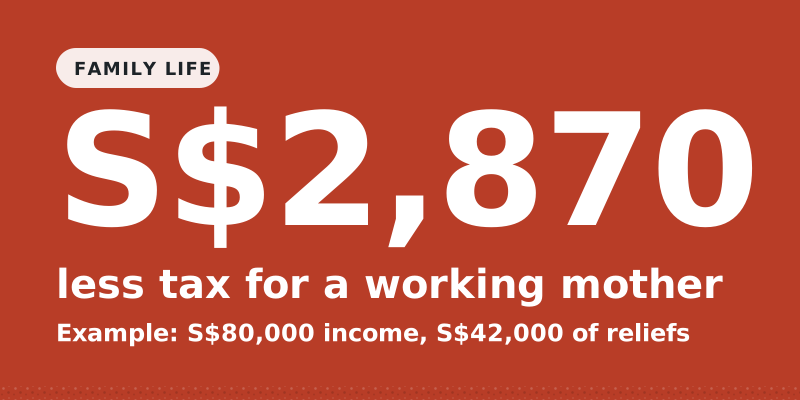
It depends on who is claiming. Either parent can claim Qualifying Child Relief (QCR) and Parent Relief. Working Mother’s Child Relief (WMCR) and Grandparent Caregiver Relief are for working mothers only. In our example, a mother earning S$80,000 with two children claims S$42,000 and pays about S$2,870 less tax; a father on the same income claims S$17,000 and saves about S$1,190. IRAS makes the final assessment.
The useful number: In the example, the same S$80,000 income saves about S$2,870 for a working mother claiming S$42,000 of reliefs, or S$1,190 for a father claiming S$17,000.
Who is this for?
Singapore tax-resident parents filing for the 2026 income year (YA2027): working mothers, fathers and single parents. The child rules were last read for YA2026 and IRAS lists no change for YA2027.
What are the steps?
- Say who is claiming: the mother or the father.
- Enter the claimant’s yearly earned income and the number of children, and how many were born or adopted from 1 January 2024.
- Choose whether to include QCR, and add any parents or grandparents you support for Parent Relief.
- If the mother is claiming and a grandparent cares for your child, include Grandparent Caregiver Relief.
- Read the reliefs, the estimated tax saved and the Parenthood Tax Rebate, then file through IRAS. IRAS’s assessment is final.
Who can claim which relief?
- Qualifying Child Relief (QCR)
- Mother or father, S$4,000 a child, can be split on an agreed basis
- Child relief (disability)
- Mother or father, S$7,500 a child instead of QCR
- Parent relief
- Anyone supporting a parent or grandparent aged 55 or over: S$9,000 living with you, S$5,500 apart, up to 2 dependants
- Working Mother’s Child Relief (WMCR)
- Working mothers who are married, divorced or widowed
- Grandparent Caregiver Relief
- Working mothers who are married, divorced or widowed: S$3,000
- Parenthood Tax Rebate
- Parents who are married, divorced or widowed; can be shared between spouses
Fathers claim QCR (or Child Relief (Disability)) and Parent Relief, and can share the Parenthood Tax Rebate. IRAS’s QCR page covers a child born to you and your spouse or ex-spouse, a step-child or a legally adopted child. It does not say how a parent who has never married claims, so ask IRAS. Anyone can claim Parent Relief, and IRAS says single taxpayers cannot claim Grandparent Caregiver Relief.
How much is each relief worth?
- WMCR, children born or adopted from 1 January 2024
- S$8,000 first, S$10,000 second, S$12,000 third and later
- WMCR, children born before 2024
- 15%, 20% and 25% of earned income
- Qualifying Child Relief (QCR)
- S$4,000 per child
- Grandparent Caregiver Relief
- S$3,000
- Parenthood Tax Rebate
- S$5,000 first, S$10,000 second, S$20,000 third and later
Child order counts every child in the family by date of birth, including older children born before 2024. So a 2024 baby after a first child born earlier is the second child, at S$10,000.
Grandparent Caregiver Relief needs a caregiver who is a parent or grandparent of the mother or her husband, lives in Singapore and earns S$8,000 or less from work. The child must be a Singapore citizen aged 12 or below. QCR needs a child earning S$8,000 or less.
How much does a S$80,000 earner save?
Two children: the first born before 2024, the second in 2024 or later. A grandparent looks after them and lives with the family.
If the mother claims every relief shown. IRAS lets a working mother claim Parent Relief and Grandparent Caregiver Relief on the same grandparent:
- WMCR, first child (15% of earned income)
- S$12,000
- QCR, first child
- S$4,000
- WMCR, second child (fixed)
- S$10,000
- QCR, second child
- S$4,000
- Grandparent Caregiver Relief
- S$3,000
- Parent Relief, grandparent living with you
- S$9,000
- Total reliefs
- S$42,000
- Estimated tax saved
- S$2,870
- Parenthood Tax Rebate across both children
- S$15,000
If the father claims instead, on the same S$80,000, he takes QCR for both children (S$8,000) and Parent Relief for the grandparent living with them (S$9,000): S$17,000 of reliefs and about S$1,190 less tax. The rebate is the same S$15,000 and can be shared between the two of you.
The rebate is given once per child, in the year of assessment after the birth, so it may already be used for an older child. Open the Parent tax relief stacker to try your own numbers.
Which caps can cut your reliefs?
- QCR is allowed first. QCR plus WMCR is capped at S$50,000 per child.
- Total WMCR for all children is capped at 100% of the mother’s earned income.
- All personal reliefs together are capped at S$80,000 a year. That includes reliefs the tool leaves out, such as earned income, CPF and SRS reliefs, so a real return can hit the cap sooner.
Why might IRAS’s figure be different?
The estimate assumes the claimant is a tax resident, claims every relief shown that IRAS allows them, and has no other reliefs. Other reliefs lower taxable income and can change the tax rate, so the real saving can be smaller or larger. Parents can split QCR and the rebate between them; the household total stays similar but each return changes.
The Parenthood Tax Rebate offsets future tax. Unused rebate carries forward and it is never paid out in cash. For the final figure, use your IRAS notice of assessment.
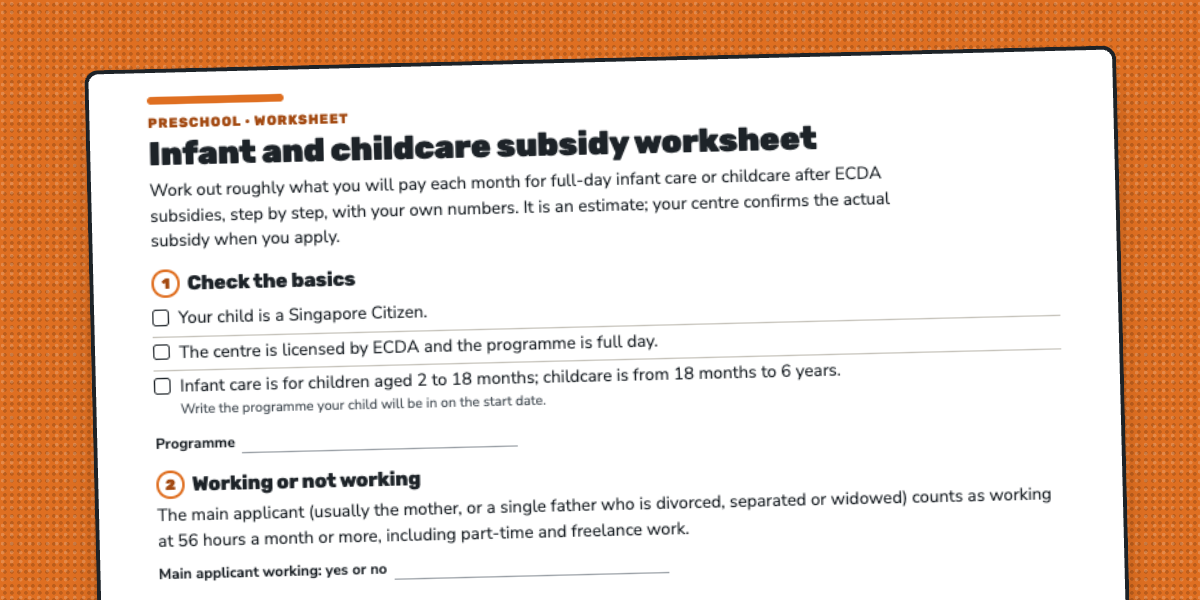
If you are budgeting for childcare as well, print the Infant and childcare subsidy worksheet. Then see how the tax saved could grow in the Education savings guide.
Printables for this guide
Infant and childcare subsidy worksheet
Work out your monthly full-day infant care or childcare fee after ECDA's basic and additional subsidies. The 2026 and 2027 bands are on one page.
Try it with your numbers
Open it with an example filled in, then change the numbers to yours.
Open parent tax relief stacker → Try it with an example →Frequently asked questions
What can a father claim?
QCR for each child, or Child Relief (Disability) for a child with disability. Parent Relief for parents or grandparents he supports. A share of the Parenthood Tax Rebate if he is married, divorced or widowed. WMCR and Grandparent Caregiver Relief are for working mothers only.
What can a single parent claim?
Anyone supporting a parent can claim Parent Relief. IRAS’s QCR page covers a child born to you and your spouse or ex-spouse, a step-child or an adopted child. It does not say how a never-married parent claims, so ask IRAS. IRAS does not allow WMCR, Grandparent Caregiver Relief or the Parenthood Tax Rebate for single taxpayers. A divorced or widowed working mother can claim WMCR and Grandparent Caregiver Relief.
Does the SG Child Support Package change any tax relief?
No. We checked on 10 October 2026: the package page lists no change to WMCR, QCR, Grandparent Caregiver Relief, the S$80,000 relief cap or the Parenthood Tax Rebate, and IRAS lists none for YA2027. Budget 2027 may change them, so we recheck in February.
What is the most we can claim in reliefs?
All personal reliefs together are capped at S$80,000 a year, including ones this tool leaves out, such as earned income, CPF and SRS reliefs. QCR plus WMCR is also capped at S$50,000 per child.
Is the Parenthood Tax Rebate paid out in cash?
No. It offsets income tax. Unused rebate carries forward to future years, parents can share it, and it is not refundable. It is S$5,000 for the first child, S$10,000 for the second and S$20,000 for each later child.
Who has the final say on our tax?
IRAS. This is an estimate to help you plan; your IRAS notice of assessment is the figure that counts. Try the Parent Tax Relief Stacker →
Keep this guide for the next big decision.
Build your own reading list and pick up where you left off with a free RaisingAngels account.
Free account · Tools stay free without an account.
Sources & assumptions
- IRAS — Working Mother’s Child Relief (WMCR) ↗
- IRAS — Qualifying Child Relief (QCR)/ Child Relief (Disability) ↗
- IRAS — Grandparent Caregiver Relief ↗
- IRAS — Parent Relief/Parent Relief (Disability) ↗
- IRAS — Parenthood Tax Rebate (PTR) ↗
- IRAS — Individual Income Tax rates ↗
- LifeSG — SG Child Support Package ↗