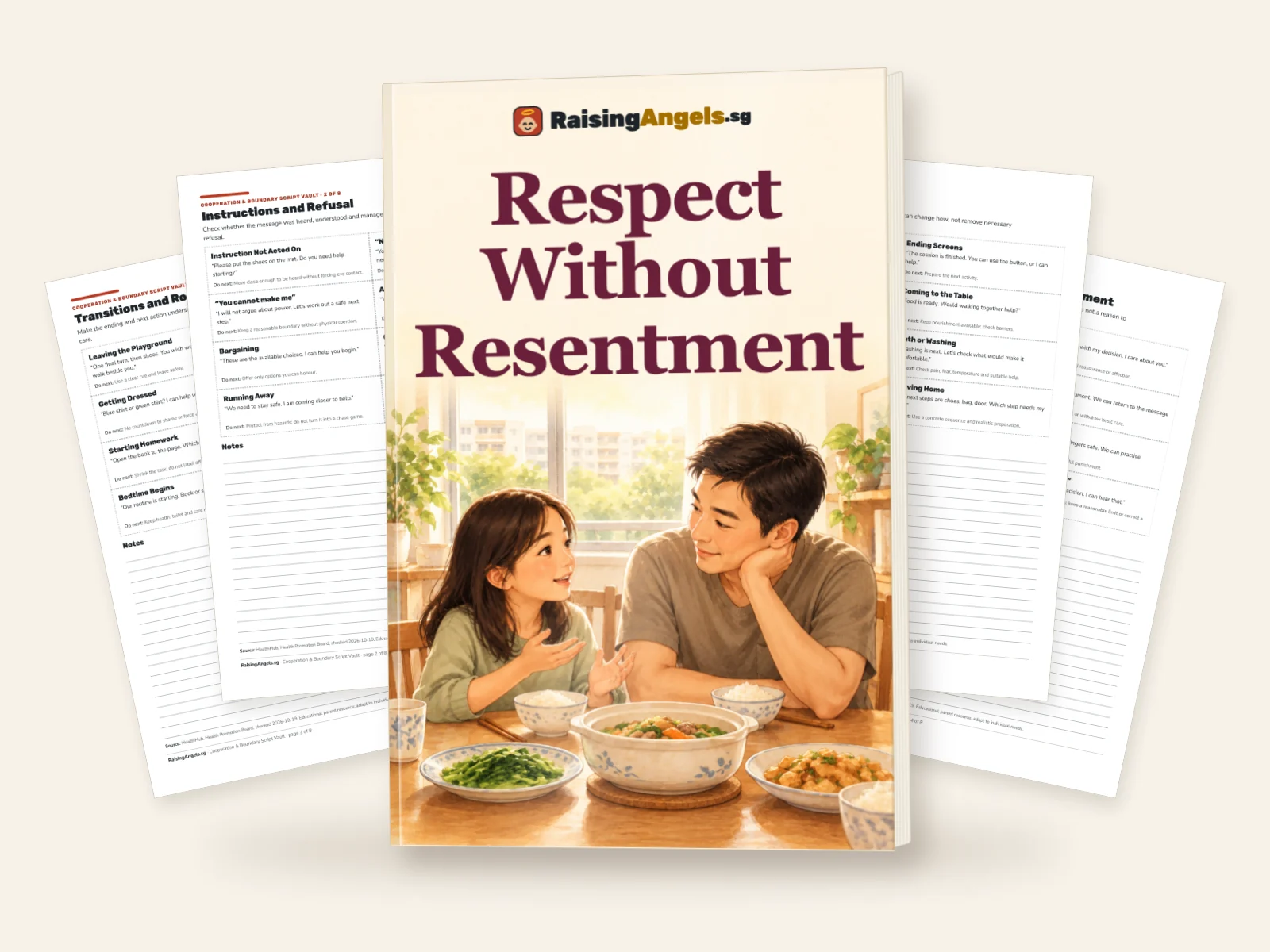
Keep a fair limit with words and follow-through you have already planned. Practise refusal and repair scripts in 6 short reading lessons, with 2 planning sheets included.
Goal: Keep a limit you need without it turning into a fight
It's 6.30pm at the playground near your block. You need to fetch his sister from class, and your son is hanging off the climbing frame shouting, "No! Five more minutes!" A few parents look over, and you feel stuck between giving in and getting stern.
This lesson shows you how to stay kind and still leave.
You can be kind and still decide. Being kind and firm means saying what needs to happen, helping your child understand, and protecting their dignity when they disagree.
The aim is cooperation that keeps everyone safe, not instant obedience or a child who never questions you. A disappointed child hasn't failed. Neither have you.
Split it into fixed and flexible. At the playground, leaving is fixed, because his sister needs fetching. The flexible part might be a goodbye wave to the slide, or carrying the water bottle.
Warm doesn't mean five more minutes after every protest. Firm doesn't mean threatening to leave him behind.
A Limit You Can Use Today
Choose a limit linked to safety, care or a real family need.
Name the wish: "You want to stay."
Say the next action: "We're leaving now."
Offer a small real choice, if there is one.
Stay with the disappointment while you make the move happen safely.
What to say
Leaving the Playground
Say
You wish we could stay. It's time to fetch your sister.
Do you want to carry the bottle or hold my hand?
I'll walk next to you while you're upset.
Avoid
Stop crying or I'm leaving without you.
Good children don't argue.
What would you do?
As you walk off with your crying son, Ah Ma, who adores him, says, "If you let him cry like that, he won't listen to you." What do you do?
Keep walking, and later tell Ah Ma: "We're still leaving. I'm helping with the upset, not changing my mind."
This keeps the limit and treats Ah Ma as part of the team. Saying it later, in private, means nobody loses face in front of your son.
Stop and tell him firmly to stop crying before you go any further
It's natural to want to show you're in charge. But stopping the tears becomes a second battle. You can leave and let him be sad at the same time.
Agree to five more minutes so everyone calms down
Giving in feels kind, and it does stop the noise. But the limit was needed, and he learns that crying moves it. Warmth doesn't need him to agree.
Quick check
When you're kind but firm, which part stays fixed?
Show the answer
The needed limit, with support for the feelings
Keep a reasonable limit clear. If a rule turns out to be wrong or unsafe, changing it is part of being in charge too.
Quick check
Your child says, "I don't like this rule." What does that tell you?
Show the answer
How they feel about it, which you can listen to
Disagreeing and cooperating can happen together. If they do something unsafe, deal with that separately.
Your private note
Saved on this device only. We never see it.
What the rest of the course covers
Lesson 2: give instructions your child can act on, and check what's in the way before you repeat them.
Lesson 3: follow-through linked to what happened, instead of angry punishments.
Lesson 4: correct behaviour without labels, and teach courtesy without forced hugs.
Lesson 5: repair after you've shouted, without asking your child to comfort you.
Lesson 6: teach a real household job step by step, and agree the words with other caregivers.
Remember
You can keep the limit and still make room for disagreement.
Try This Week
For 3 days, use one kind, firm limit at a moment that happens every day, like leaving the playground or bath time.
Read about the lesson format, included sheets, access and refunds before you decide.
Does being kind mean giving in?
The course starts with what stays fixed and where your child has a choice. It then covers clear instructions and related follow-through, so you can keep a fair limit kindly.
Do I need to finish it all at once?
No. Read one short lesson at a time on your phone or computer. The lessons total 43 minutes. Take the practice into your day as you go.
Is this a video course?
These are read-at-your-own-pace lessons with scripts, checklists, practice situations and quick checks. Try the full free lesson to see the format before buying.
What printables are included?
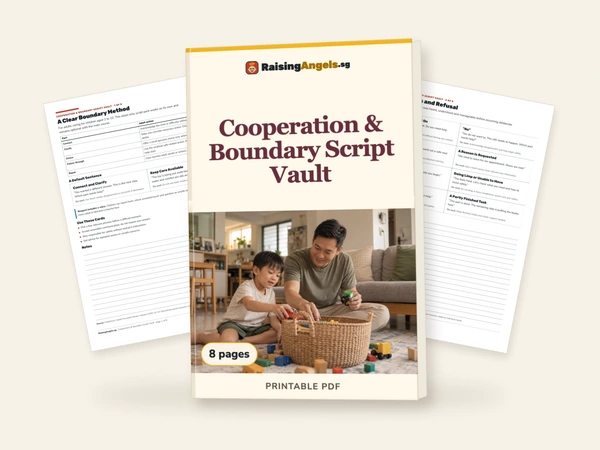
Your course includes 2 pages of printable practice sheets. The optional Cooperation & Boundary Script Vault is a separate pack, at S$6.90 with the course or S$7.90 on its own.
How do I get the course after paying?
Sign in or create a free account before paying through Stripe. After payment, open the lessons in My Family Plan. Download any included course sheets there too.
What if it isn’t right for our family?
Email contact@raisingangels.sg within 14 days of buying for a full refund. Your access to that course ends when the refund is made.
How long can I use it?
You have access for as long as RaisingAngels.sg offers the course. You can return to the lessons during that time.