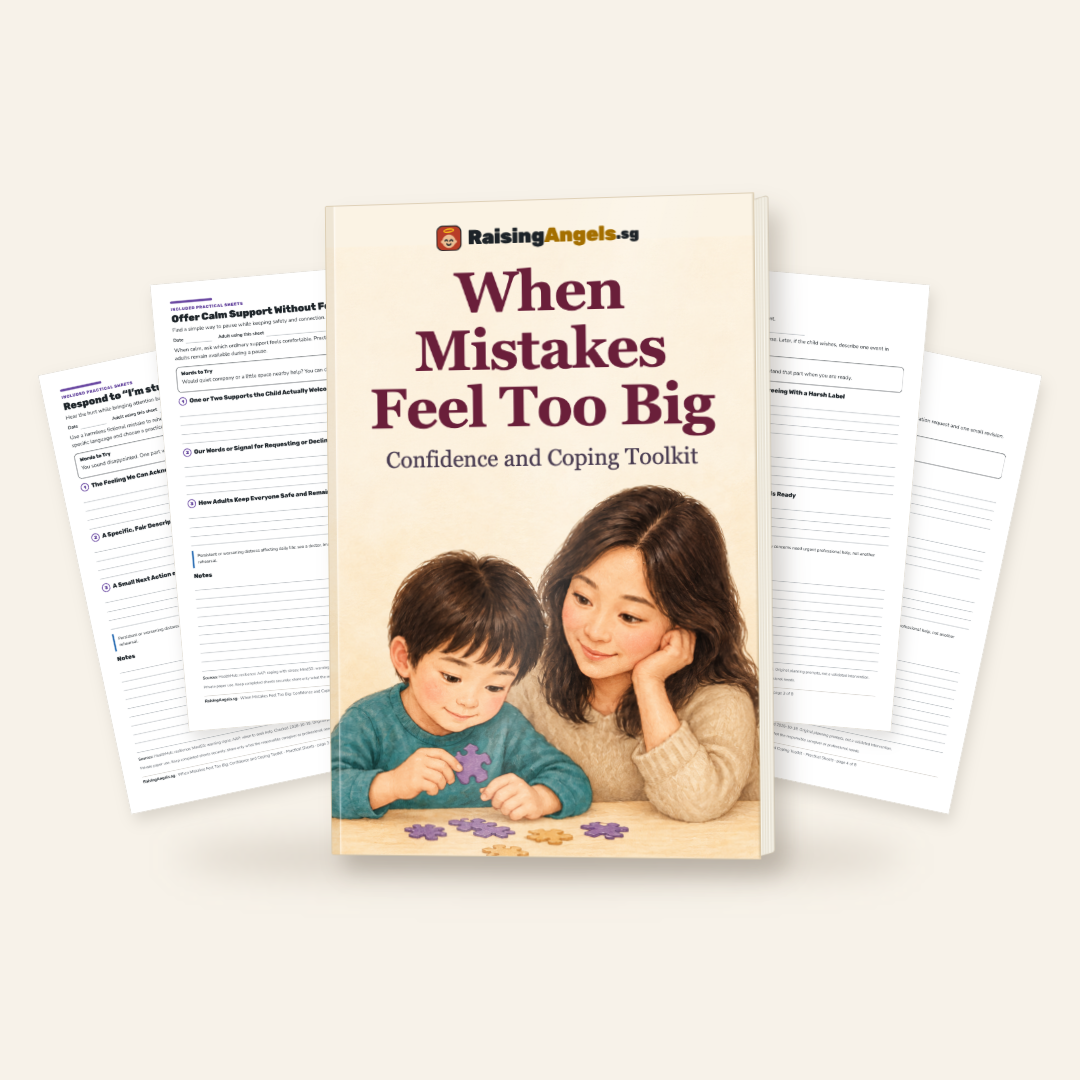
When Mistakes Feel Too Big: Confidence and Coping Toolkit: painted workbook cover of a fictional Singapore family, with real practical-sheet pages behind it.

Self-paced course

When Mistakes Feel Too Big: Confidence and Coping Toolkit

Help Your Child Take the Next Step After a Mistake

Have words ready for “I’m stupid”, corrections and losing. Practise one response at a time, without demanding a whole page or another try straight away.

One payment · Usual price S$14.90 now S$12.90 MEMBERS’ PRICE · usual price S$14.90

Buy the coping course · S$12.90Read the free shutdown-response lesson

Who This Is For

Parents, grandparents and helpers of children aged 6 to 12 who push work away, melt down or put themselves down after a mistake.

Choose this for mistakes, corrections and losing; choose Homework Independence Toolkit if starting and finishing work is the main difficulty.

Have Words Ready When Reassurance Isn’t Helping

Respond to “I’m stupid”, help with one correction and plan support across home, school and CCA.

One Correction, One Retry, Not the Whole Page

  • You have an answer ready when reassurance turns into an argument.
  • You can help with one correction or one retry, without demanding a whole page at once.
  • You can map support at home, school and CCA, and recognise the course’s signs for getting more help.

When “You’re Clever” Doesn’t Stop “I’m Stupid”

  • One red mark and the whole workbook gets pushed away.
  • You say “you’re clever”, but your child keeps saying “I’m stupid”.
  • A lost game ends in tears, and you don’t know whether to comfort or correct.

What Your Payment Includes

  • 6 short lessons, 51 minutes in all, to read at your own pace
  • 6 what-to-say cards to practise before you need the words
  • 6 practice situations with feedback on the response you choose
  • 11 quick checks so you can check your understanding, with answers explained
  • Checklists and notes saved on the device you use
  • 8 pages of printable practice sheets included
  • A completion certificate you can print

Scripts for Shutdowns, Corrections and Losing

  • Spot the moment before a shutdown and choose your first response.
  • Use the “I’m stupid” script to hear the hurt and return to the one thing that happened.
  • Offer calm support your child can accept or decline, without forcing deep breaths.
  • Break a correction into one useful instruction, so you know where to start together.
  • Practise a pause after losing, then help your child choose a supported next step.
  • Use the 8 pages of included practice sheets for response words, a support map and flexible practice.

A Look Inside the Course

6 lessons, 51 minutes in all. Start with the part you need and work at your own pace.

  1. The Moment Before the Shutdown

    Spot the first sign that a mistake feels too big, and know what to say first

    9 min · Free to read

  2. Calm Support Your Child Can Say No To

    Find a calm support your child actually wants, while keeping everyone safe

    8 min · In the course

  3. When Your Child Says "I'm stupid"

    Hear the hurt, then bring the talk back to the one thing that happened

    9 min · In the course

  4. Taking a Correction, One Part at a Time

    Help your child find the one useful instruction in a correction, without feeling small

    8 min · In the course

  5. Losing a Game, and Trying Again

    Practise losing fairly, with a pause and a next step your child chooses

    8 min · In the course

  6. A Support Plan, and When to Get More Help

    Ease the pressures adults control, line up trusted adults, and know when home practice isn't enough

    9 min · In the course

Get the remaining 5 lessons on corrections and setbacks →

Try a full lesson free

Lesson 1 of 6 · 9 min

The Moment Before the Shutdown

Goal: Spot the first sign that a mistake feels too big, and know what to say first

It's 8pm in the HDB flat. Your daughter sees the red marks on her spelling and pushes the book away. "I'm never writing again." You want to tell her it's only one word, and you can feel the whole evening slipping.

This lesson shows you how to spot that moment early, and what to say before you try to fix anything.

Look before you decide what it means. A clenched pencil, silence, tears, a sharp voice or a page pushed away tells you something feels hard. It doesn't tell you why. Your child may be tired, confused, disappointed or worried about how you'll react.

So describe what you see to yourself, and leave room for their side of the story. A wrong spelling word, an unclear instruction and an unkind comment from a classmate all look the same from the outside. Each needs different help.

Your Three Moves When You See the First Sign

  1. Notice. Name to yourself what you can see: tight grip, tears, going quiet.
  2. Slow down. Lower your voice and give one short sentence, not a list of instructions. Move away from siblings or visitors if you can.
  3. Ask about the real problem later. Once they're calmer, ask which part felt hard. Then help with that part, or with what's around it.

What to say

Your Child Pushes the Homework Away

Say

  • That correction felt hard. I'm here.
  • We can look at the next step when you're ready.
  • Later: Which part felt the hardest?

Avoid

  • It's so easy, why are you crying?
  • Stop being so dramatic.
  • Your brother never makes a fuss about this.

What would you do?

Your P2 daughter, Wei Ling, tears up after one spelling correction and says, "I'm never writing again." Dinner is almost ready. What do you do?

  • Tell her it's only one word and it's quite easy

    It's natural to want to shrink the problem. But to her it doesn't feel easy yet, and hearing that can add embarrassment. Say what you see first: "That felt hard." The word can wait a few minutes.

  • Say "That felt hard. I'm here," and sit with her for a bit

    She hears that you noticed, without a lecture. Once she's calmer, ask which part felt hard and help with one word.

  • Keep going so the list is finished before dinner

    You're trying to keep the evening on track, and that makes sense. But pushing on while she's this upset usually takes longer. A short pause first often gets the work done sooner.

Fit it to your child's age. For ages 6 to 8, use one short sentence and let them point or draw instead of talking. For ages 9 to 12, ask what they'd like: someone to listen, some company, or practical help. Adjust for how your child communicates and what they find too loud or too much.

If they can't say what's wrong, stop asking. Offer quiet company and come back to it later.

If you're getting angry too, take a short pause yourself, while your child is still with another adult or where you can see them.

Quick check

Your child grips the pencil tight and goes quiet. What does that tell you?

Show the answer

Something feels hard. You don't know what yet, so notice it and ask later

The same sign can come from tiredness, confusion or worry. Notice it, stay calm, and find out what's behind it once they can talk.

Quick check

Later, your child tells you the red marks felt embarrassing. What's a useful next step?

Show the answer

Help with one word, and think about whether the way feedback is given needs a chat with the teacher

Respond to the situation as well as the feeling. Sometimes the fix is in the task or the feedback, not only in how your child copes.

Ready for the Next Hard Moment

Your ticks stay on this device.

Your private note

Saved on this device only. We never see it.

What the rest of the course covers

  • Lesson 2: offer calm support your child can say yes or no to, without forcing deep breaths.
  • Lesson 3: what to say when your child says "I'm stupid".
  • Lesson 4: help your child take a correction one small part at a time.
  • Lesson 5: losing a game, and trying again without extra pressure.
  • Lesson 6: ease the pressure around your child, line up trusted adults, and know when to get more help.

Remember

Notice what you see, say one calm line, and work out what it means later.

Try This Week

For 3 days, say your one line out loud when everyone is calm, so it comes easily at the next hard moment.

Sources

Try the checklist or write a note. The lesson player keeps them on this device. Practise “The Moment Before the Shutdown” in the player →

Questions Before You Buy

Read about the lesson format, included sheets, access and refunds before you decide.

Will this make my child confident straight away?

It gives you responses and small practice steps for specific hard moments. Start with one correction or one lost game, then use the support plan to decide what help comes next.

Do I need to finish it all at once?

No. Read one short lesson at a time on your phone or computer. The lessons total 51 minutes. Take the practice into your day as you go.

Is this a video course?

These are read-at-your-own-pace lessons with scripts, checklists, practice situations and quick checks. Try the full free lesson to see the format before buying.

What printables are included?

Your course includes 8 pages of printable practice sheets. The optional Shared Encouragement & School–CCA Conversation Pack is a separate pack, at S$6.90 with the course or S$7.90 on its own.

How do I get the course after paying?

Sign in or create a free account before paying through Stripe. After payment, open the lessons in My Family Plan. Download any included course sheets there too.

What if it isn’t right for our family?

Email contact@raisingangels.sg within 14 days of buying for a full refund. Your access to that course ends when the refund is made.

How long can I use it?

You have access for as long as RaisingAngels.sg offers the course. You can return to the lessons during that time.

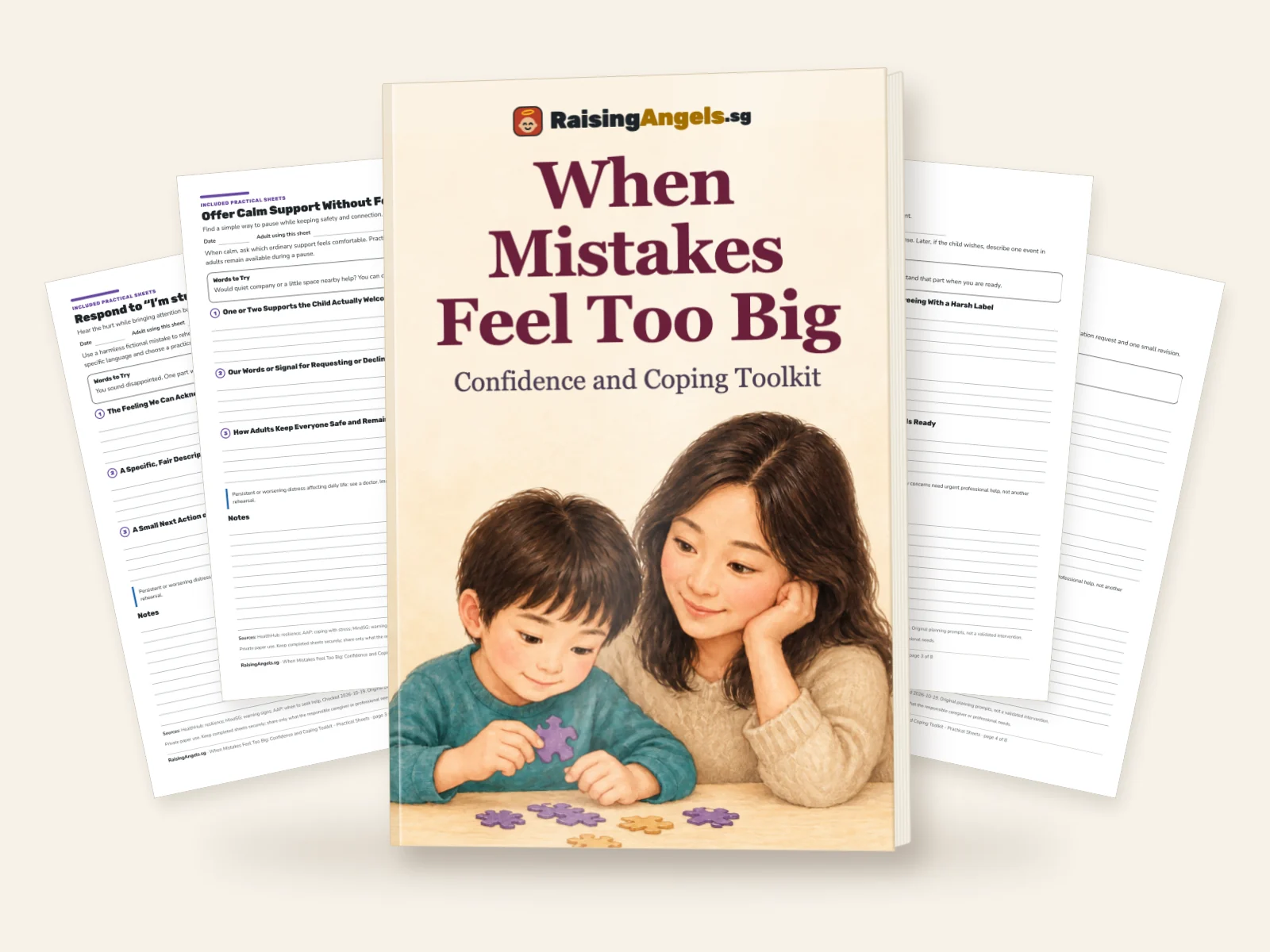
When Mistakes Feel Too Big: Confidence and Coping Toolkit: painted workbook cover of a fictional Singapore family, with real practical-sheet pages behind it.

Prepare for the Next Correction or Lost Game

Usual price S$14.90 now S$12.90 MEMBERS’ PRICE · usual price S$14.90

Start with one correction your child can face with support. Keep response words and a support map ready for the next difficult evening.

Read all 6 lessons at your own pace on your phone or computer. After payment, open the course in My Family Plan.

You’ll sign in or create a free account, then pay through Stripe. One payment for this course.

Not for you? Full refund within 14 days.

Buying opens soon. Questions? Email contact@raisingangels.sg.

Email contact@raisingangels.sg within 14 days of buying. Your course access ends when the refund is made.

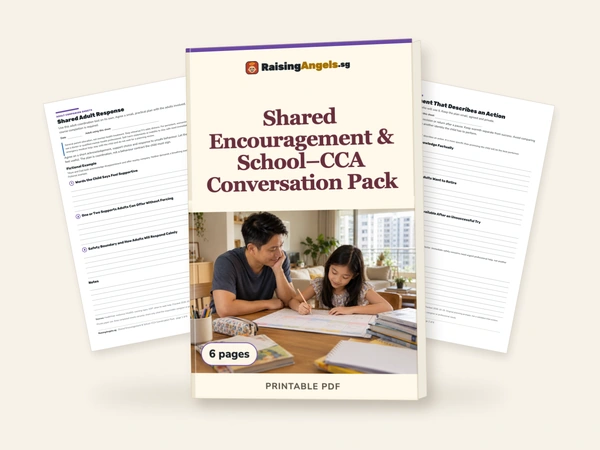
Shared Encouragement & School–CCA Conversation Pack: printable pack showing its first two real pages; 6 pages.

Prefer the Companion Pack on Its Own?

The Shared Encouragement & School–CCA Conversation Pack is S$7.90 on its own. This buys the companion pack, without the course lessons.

Not for you? Full refund within 14 days.

Need Help With More Than One Worry?

Choose a bundle below. Each lists the courses it includes and its total price.

Primary School Bundle

Get 4, Pay for 3

Bought one by one S$51.60 now S$38.70

  • Homework Independence Toolkit
  • When Mistakes Feel Too Big
  • First Phone and Online Safety Family Kit
  • Puberty Conversations Made Easier

Not for you? Full refund within 14 days.

Everything Bundle

All 16 Courses

Bought one by one S$206.40 now S$99

See the 16 courses
  • Before Baby Arrives
  • When Mistakes Feel Too Big
  • First Phone and Online Safety Family Kit
  • Homework Independence Toolkit
  • No More Screen Time
  • No More Whining
  • No More Yelling
  • Puberty Conversations Made Easier
  • Ready for P1
  • Respect Without Resentment
  • Seven-Day Sleep Reset
  • Sibling Conflict Toolkit
  • Singapore Picky Eating Toolkit
  • Starting Childcare
  • No More Tantrums
  • Toilet Training and Troubleshooting Toolkit

Not for you? Full refund within 14 days.