Quick answer
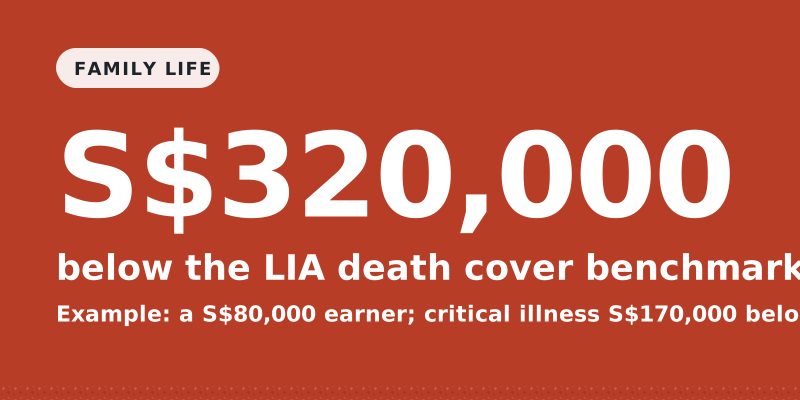
The Life Insurance Association’s Protection Gap Study 2022 uses a rule of thumb of about 9 times annual income for death cover and about 4 times for critical illness cover. A parent earning S$80,000 a year with S$400,000 of death cover and S$150,000 of critical illness cover is S$320,000 and S$170,000 below those benchmarks. That is a comparison with a population average.
The useful number: In the example, a S$80,000 earner’s death cover is S$320,000 below the LIA benchmark. Critical illness cover is S$170,000 below its own benchmark.
Who is this for?
Working parents who want a quick, neutral check of the cover they already hold, before a policy review or after a new baby, a home loan or a change of job.
What are the steps?
- Gather each working parent’s policy summaries and add up the death cover and the critical illness cover.
- Enter one parent’s yearly income and those two totals.
- Read the benchmark and the gap for each kind of cover.
- Repeat for the other working parent.
- Take the result to a policy review as a starting question, not a shopping list.
Where do 9 times and 4 times come from?
The Life Insurance Association, Singapore (LIA), published its Protection Gap Study 2022 on 8 September 2023. It is the latest edition: LIA has run the study about every five years (2012, 2017 and 2022), and no newer one had been published when we checked on 10 October 2026. Its rule of thumb for death protection is about 9 to 10 times annual income; the tool uses 9. For critical illness it is about 4 times annual income, assuming a 5-year recovery period.
These are population averages. LIA notes that the right multiple differs with your dependants and income, and that savings can meet part of the need as well as insurance. LIA is an industry association, not a regulator.
What does the check show for a S$80,000 earner?
One parent earns S$80,000 a year and holds S$400,000 of death cover and S$150,000 of critical illness cover:
- Death cover benchmark, 9 times income
- S$720,000
- Death cover held
- S$400,000
- Below the death benchmark
- S$320,000
- Critical illness benchmark, 4 times income
- S$320,000
- Critical illness cover held
- S$150,000
- Below the critical illness benchmark
- S$170,000
The two benchmarks are separate, so we do not add the gaps. Open the Family insurance gap checker to run the same check with your own figures. Income figures stay on your device and are hidden on the share card by default.
What can a benchmark not tell you?
It cannot tell you what your own family needs. That depends on your debts, your children’s ages, your savings, your spouse’s income and the support you want to leave. A gap is a prompt to look closer, not proof that you are under-insured.
We never name, rank or recommend an insurer or a product, and this is not financial advice. For advice on your situation, speak with a licensed financial adviser representative, and compare like with like when you read any quote.
What else protects the family if a parent falls ill?
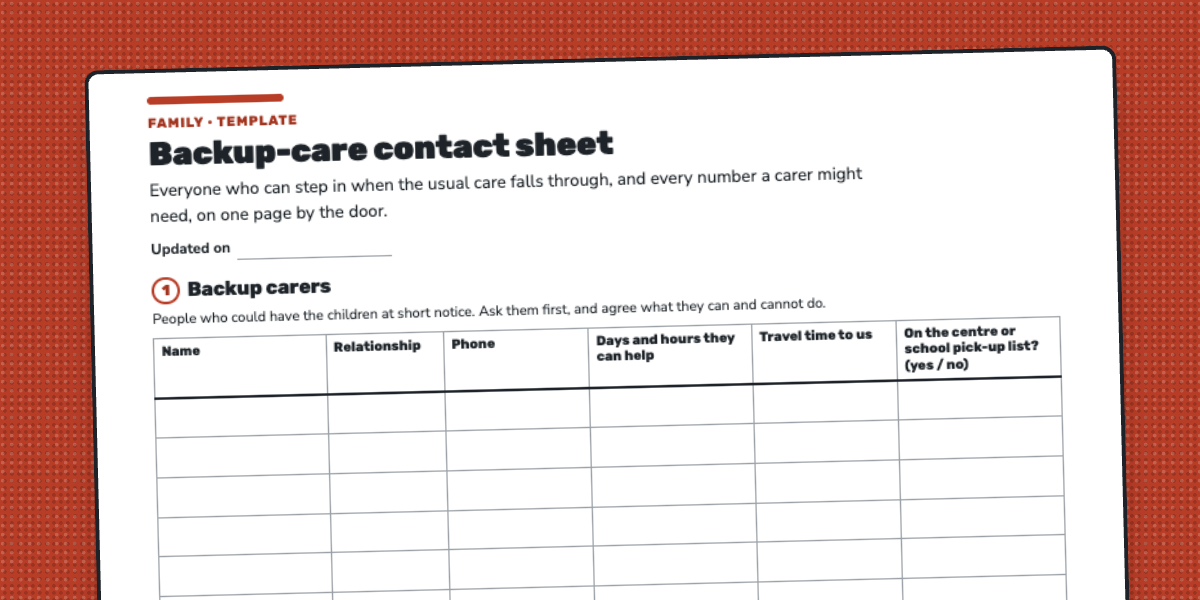
Money is one part. The other is who steps in for pickups, meals and care. Write that down with the Backup-care contact sheet. To see how savings for your child are tracking, read the Education savings guide.
Printables for this guide
Backup-care contact sheet
Every backup carer's hours, travel time and pick-up authorisation on one page. Add the centre, school, clinic and work numbers a carer might need.
Try it with your numbers
Open it with an example filled in, then change the numbers to yours.
Open family insurance gap checker → Try it with an example →Frequently asked questions
Why does the checker use 9 times income?
LIA’s Protection Gap Study 2022 gives a rule of thumb of about 9 to 10 times annual income for death protection. The tool uses the lower end, 9 times. For critical illness the rule of thumb is about 4 times annual income.
Which insurer or policy should we choose?
We do not say. RaisingAngels.sg never names, ranks or recommends insurers or products. Use the result as a question to raise with a licensed adviser.
Do savings count towards the benchmark?
LIA notes that savings can meet part of the need as well as insurance. The tool only compares the cover you enter, so if you hold savings set aside for this, take them into account when you read the gap.
Is a gap a sign we are under-insured?
Not on its own. The benchmark is a population average, and LIA says the multiple differs with dependants and income. A gap is a prompt to look closer at your own needs. Try the insurance gap checker →
Keep this guide for the next big decision.
Build your own reading list and pick up where you left off with a free RaisingAngels account.
Free account · Tools stay free without an account.