
Quick answer
In P1 and P2, MOE’s Malay syllabus builds six skills around self, family and school: listening, reading, speaking, writing, spoken and written interaction. There are no exams in P1 and P2. Reading aloud and chatting in Malay at home use the same skills.
The useful number: P1 and P2 have 12 Malay periods a week of 30 minutes, and no weighted assessments or exams.
Who is this for?
Parents of a child in P1 or P2 who takes Malay as their Mother Tongue Language, including parents who speak little Malay. It sums up MOE’s syllabus and free help from MLLPC and NLB.
Every child learns a Mother Tongue Language in primary school: Chinese, Malay or Tamil. Malay pupils take Malay.
What does the syllabus cover in P1 and P2?
MOE’s Malay Language Teaching and Learning Syllabus for Primary School 2024 builds six skills. By the end of P2, a child works towards these (our plain summary of MOE’s Malay text):
- Listening
- Understand short, simple texts about self, family and school, spoken clearly and slowly.
- Reading
- Read short texts about self, family and school aloud and silently, and understand them.
- Speaking
- Talk about self, family and school with help from words, simple sentences or pictures, with suitable pronunciation and intonation.
- Writing
- Write simple sentences with simple words, using pictures as prompts.
- Spoken interaction
- Chat about self, family and school.
- Written interaction
- Write or type short, simple messages.
Reading aloud starts from sounds: vowels, consonants, diphthongs and syllables, read in standard pronunciation. P1 and P2 have 12 Malay Language periods a week, each 30 minutes. There are no weighted assessments, mid-year or end-of-year exams in P1 and P2. Higher Malay and Foundation Malay appear only from P5.
What does a week at home look like?
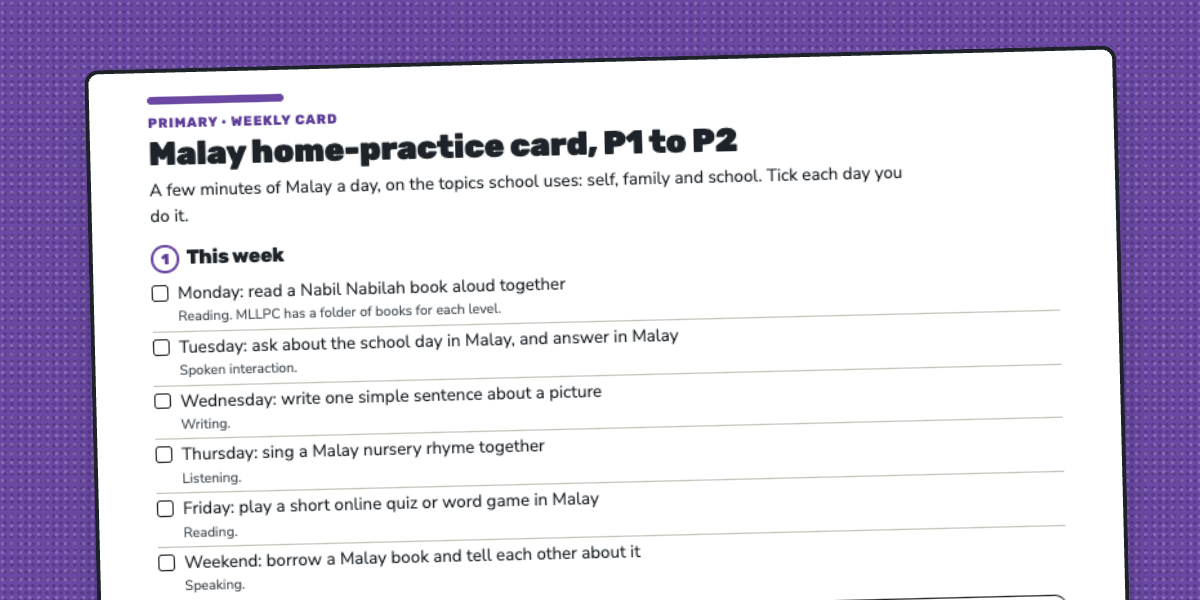
A short, regular habit, around the topics school uses: self, family and school. Our example week, built from the syllabus skills and MOE’s Schoolbag ideas:
- Monday
- Read a Nabil Nabilah book aloud together (reading).
- Tuesday
- Ask about the school day in Malay, and answer in Malay (spoken interaction).
- Wednesday
- Write one simple sentence about a picture (writing).
- Thursday
- Sing a Malay nursery rhyme together (listening).
- Friday
- Play a short online quiz or word game in Malay (reading).
- Weekend
- Borrow a Malay book from the library and tell each other about it (speaking).
Print the Malay home-practice card, P1 to P2 to tick off each day.
What help does MLLPC offer?
MOE set up MLLPC in February 2006 to build children's interest in Malay, its literature and culture. MLLPC's Nabil Nabilah reading series runs from preschool to P6, with a folder of books for each level. MOE says the series has 62 storybooks from K1 to P6, first used in 2015 for P1 and P2. Parents can also use MLLPC's online worksheets at home.
Find the books on MLLPC’s Nabil Nabilah page. Bulan Bahasa, the Malay Language Month, ran from 14 August to 11 October 2026. It has been held since 1988.
Where can we borrow Malay books?
NLB has about 167,100 Malay books for children aged 0 to 12, counting physical books, e-books and audiobooks. Search NLB’s catalogue and pick Malay as the language, or ask at your nearest library.
What does this guide not tell you?
It does not assess your child’s Malay. If you are worried about their progress, ask the Malay teacher. The example week is ours, not MOE’s: change it to suit your child.
Printables for this guide
Malay home-practice card, P1 to P2
One card a week for P1 and P2 Malay at home: read aloud, chat, write, sing and play. Built on the syllabus topics of self, family and school.
Practise a little each week
One card a week: a book to read aloud, a chat, a sentence to write and a song.
Print the weekly practice card → Plan the move to P1 →Frequently asked questions
Are there Malay exams in P1 and P2?
No. MOE’s 2024 syllabus says there are no weighted assessments, mid-year or end-of-year exams in P1 and P2.
I do not speak much Malay. Can I still help?
Yes. Read the books together, sing the songs and play the games. Ask your child to teach you new words from school.
When does Higher Malay start?
In MOE’s syllabus, Higher Malay and Foundation Malay appear from P5.
Where do we find the Nabil Nabilah books?
On MLLPC’s Nabil Nabilah page, which has a folder of books for each level from K1 to P6.
Keep this guide for the next big decision.
Build your own reading list and pick up where you left off with a free RaisingAngels account.
Free account · Tools stay free without an account.
Sources & assumptions
- MOE Malay Language syllabus (primary), 2024 ↗
- MOE — Malay Language teaching resources ↗
- MOE Mother Tongue Languages ↗
- MLLPC ↗
- MLLPC Siri Bacaan Nabil Nabilah ↗
- MOE press release on Nabil Nabilah ↗
- Schoolbag (MOE): mother tongue at home ↗
- MDDI written answer on NLB's children's books ↗
- Majlis Bahasa Melayu Singapura: Bulan Bahasa ↗