Quick answer
HealthHub says screening is now offered to all mothers regardless of age. First-trimester screening is at 11 to 14 weeks and NIPT from 10 weeks. Each tells you a chance, not an answer. CVS and amniocentesis give an answer but carry a small miscarriage risk.
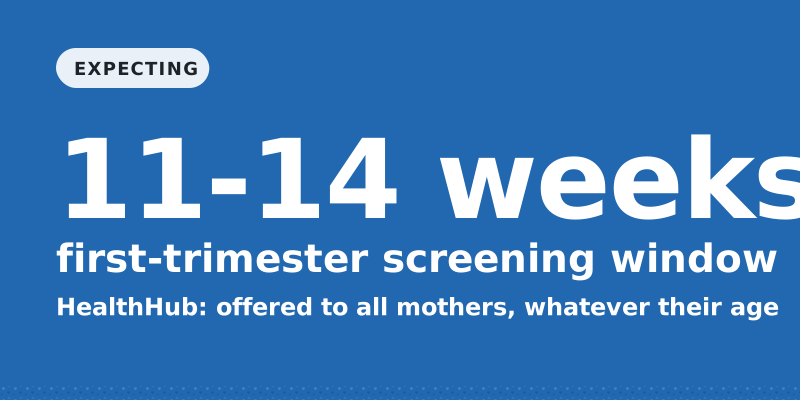
The useful number: First-trimester screening is at 11-14 weeks, HealthHub says, and it is offered to all mothers regardless of their age.
Who is this for?
Anyone pregnant at 35 or older, including after IVF, and their partner. It sets out what HealthHub, KKH, SGH, NUH, CPF and MOH say. Your obstetrician decides which tests suit you.
HealthHub: “Down syndrome screening is optional and whether you should have one is a decision that only you and your spouse can make”.
What changes at 35?
HealthHub: “The risk of having a child with Down syndrome increases with the age of the mother although it can occur at any age”.
HealthHub: “In the past, mothers over the age of 35 were offered amniocentesis or chorionic villous sampling”. It says screening tests now “are non-invasive and are offered to all mothers regardless of their age”.
KKH: “If you are 35 years or older, your obstetrician will discuss amniocentesis with you, for the detection of Down Syndrome”.
KKH also notes: “You might be surprised to know that the majority of babies with Down syndrome are born to young women”.
Screening or diagnostic: what is the difference?
- Screening tests
- First-trimester screening and NIPT. HealthHub: “These tests do not tell you if you have a Down syndrome baby but tell you your risk of having one”.
- Diagnostic tests
- CVS and amniocentesis. KKH: “Diagnostic tests can identify whether the pregnancy is affected by a certain condition”.
- Screen positive
- HealthHub: “If the screening test shows that the risk of Down syndrome is higher than 1 in 300, you are screen positive”.
When is each test done?
| Test | When, in the official page’s words | Source |
|---|---|---|
| First-trimester screening (scan and blood test) Screening (shows a chance) | “This test combines both nuchal translucency as well as a maternal blood test at 11-14 weeks”. | HealthHub (HPB) |
| NIPT (blood test) Screening (shows a chance) | “This can be performed from 10 weeks of pregnancy”. | SingHealth (SGH) |
| CVS (chorionic villus sampling) Diagnostic (gives an answer) | “It is usually performed about 10-13 weeks”. “The risk of miscarriage is about 1%”. | HealthHub (HPB) |
| Amniocentesis Diagnostic (gives an answer) | “This is performed at 15-20 weeks”. “It carries a small risk of 0.5% to 1% of miscarriage”. | HealthHub (HPB) |
| Detailed scan (anomaly scan) Scan | “The purpose of this scan is to make sure the baby is growing well and there are no major physical defects”. | HealthHub (HPB) |
What KKH says about first-trimester screening and NIPT
“The ultrasound scan is done between 11 weeks and 13 weeks + 6 days gestation”. “This blood test is done between 9 weeks and 13 weeks + 6 days gestation”.
“NIPT is a blood test, and does not screen for structural defects such as heart defects in the baby”. “Hence, we recommend FTS to be done regardless of your decision on NIPT”.
KKH’s windows and risk for CVS and amniocentesis
“CVS is typically done between 10 to 14 weeks of pregnancy”. For amniocentesis: “This is typically done after 16 weeks of pregnancy”.
“The risk of miscarriage associated with CVS and amniocentesis at KKH is 0.3% (1 in 300)”.
The official pages give slightly different windows and risks. Ask your doctor which applies at your hospital.
See these windows against your own dates with the Due date and antenatal timeline.
What do the tests cost?
KKH and NUH do not publish prices for first-trimester screening, NIPT, CVS or amniocentesis. Ask your clinic for a written estimate before you book.
The one published hospital estimate is NUH’s Fetal Medicine Clinic leaflet. That clinic sees couples whose baby has been found to have a condition.
- First visit, NUH Fetal Medicine Clinic
- S$870 to S$1,070, including 9% GST
- Prenatal genetic tests, NUH estimate
- S$500 to S$8,000, not counting the CVS or amniocentesis itself
NUH: “Charges may differ for Singapore Citizens, Permanent Residents, Resident Foreigners and Non-Residents”. Private clinics set their own prices; none is published on an official page we read.
What does MediSave cover?
CPF’s MediSave Maternity Package allows up to S$900 for pre-delivery medical expenses. CPF: “This covers consultations, ultrasound scans, tests, and medications”.
No official page we read names NIPT, first-trimester screening, CVS or amniocentesis as claimable or excluded. Ask your hospital before the test.
CPF: “You can only use MediSave for pre-delivery expenses after you have delivered”. “The MMP applies to Singapore citizens and permanent residents”.
- Vaginal delivery (normal)
- S$1,120 for the delivery itself; S$2,020 with up to S$900 of pre-delivery care
- Vaginal delivery (assisted)
- S$1,390 for the delivery itself; S$2,290 with up to S$900 of pre-delivery care
- Caesarean section (normal)
- S$2,380 for the delivery itself; S$3,280 with up to S$900 of pre-delivery care
- Daily hospital charges
- Up to S$1,130 a day for the first 2 days and S$400 a day after
CPF lists three kinds of expenses: pre-delivery care, the delivery itself and daily hospital charges. It does not give one total for all three. Our delivery tools add the three limits, as CPF lists them separately. Ask the hospital what it will claim. See your own bill with the Delivery bill estimator.
What about IVF?
No official page we read gives separate screening advice for a pregnancy after IVF. Ask your fertility doctor and obstetrician.
For IVF itself, Made For Families lists government co-funding at public hospital centres:
- Who
- You are below 40 at the start of the cycle, with exceptions for the last cycles
- Cycles
- up to three fresh and three frozen Assisted Reproduction Technology cycles
- Fresh cycle, Singapore Citizen couple
- 75%, up to S$7,700
- Frozen cycle, Singapore Citizen couple
- 75%, up to S$2,200
- MediSave
- Up to S$6,000 for the first cycle, S$5,000 for the second, S$4,000 after; S$15,000 in a lifetime
MOH says embryo testing for chromosome problems (PGT-A) “is currently being carried out as a pilot project at public Assisted Reproduction centres”. The pilot is for women aged 35 years and above who had two or more of one of these:
- “recurrent implantation failures”
- “pregnancy losses”
- “embryos or fetuses with chromosomal abnormalities”
What should we ask the doctor?
A short list to take to your antenatal visit. None of these has a right answer; they help you decide.
- Which screening tests do you offer, and in which weeks?
- Do you recommend first-trimester screening as well as NIPT for me?
- What does each test cost here, and can MediSave pay for it?
- If a result shows a higher chance, what happens next, and how soon?
- What is the miscarriage risk of CVS or amniocentesis at this hospital?
- Can we speak to a genetic counsellor?
- After IVF: does anything change for my screening?
KKH’s maternal fetal medicine team: “These include obstetricians, clinical nurses, genetic counsellors and neonatologists”. NUH’s obstetrics page lists: “Detailed scan at 20 weeks to screen for structural abnormalities”.
What does this guide not tell you?
It does not tell you which test to choose. Each pregnancy is different. Your obstetrician will explain your options and results.
Printables for this guide
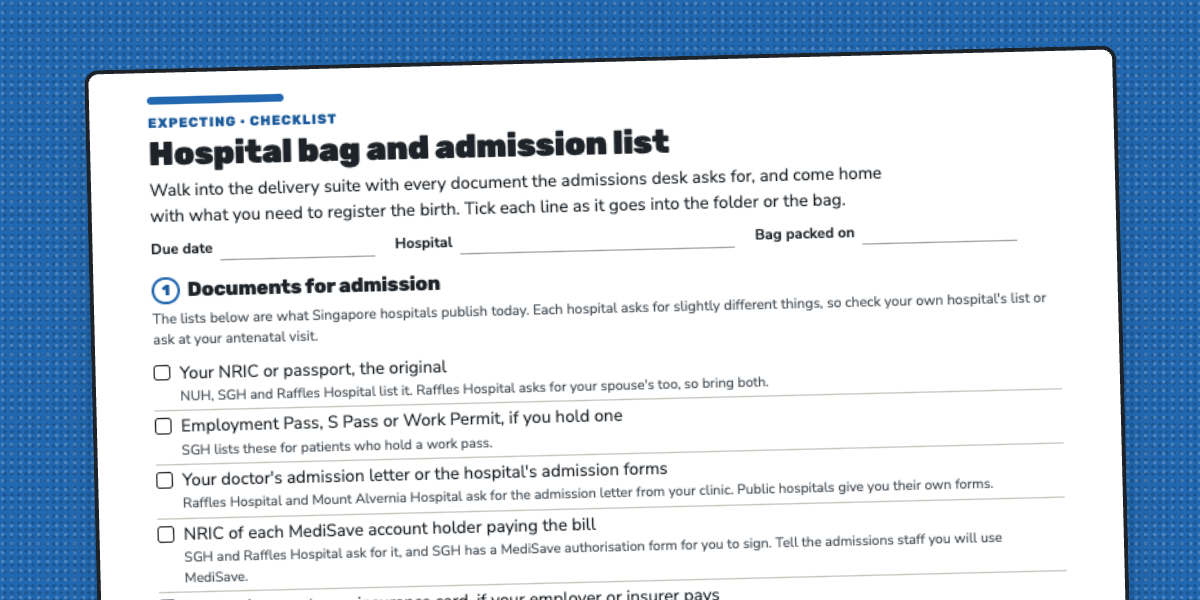
Hospital bag and admission list
The documents Singapore hospitals ask for at admission and for birth registration. Plus a light packing list for mum, baby and partner, for heat and cold wards.
See your own dates
Put in your due date or IVF transfer date to see when each test window opens.
Date the screening windows to your pregnancy → Delivery bill and MediSave → Born early or twins →Frequently asked questions
Is NIPT a diagnosis?
No. NIPT is a screening test: it gives a chance, not an answer. KKH says it “does not screen for structural defects such as heart defects in the baby” and recommends first-trimester screening as well.
Must I have amniocentesis because I am over 35?
No. HealthHub says screening is “offered to all mothers regardless of their age”, and that screening is your and your spouse’s choice. KKH says your obstetrician will discuss amniocentesis with you.
Can I use MediSave for NIPT?
CPF says the S$900 pre-delivery limit covers consultations, ultrasound scans, tests and medications. No official page names NIPT. Ask your hospital, and keep the bills for claiming after delivery.
When is first-trimester screening done?
HealthHub says 11-14 weeks. KKH gives the scan as 11 weeks to 13 weeks and 6 days, and the blood test from 9 weeks.
Is IVF co-funded after 40?
Made For Families says co-funding is for women below 40 at the start of the cycle. Up to two of the six cycles can be later, if treatment started before 40.
Keep this guide for the next big decision.
Build your own reading list and pick up where you left off with a free RaisingAngels account.
Free account · Tools stay free without an account.
Sources & assumptions
- HealthHub (HPB) — Tests for me and my baby ↗
- SingHealth (KKH obstetrics and gynaecology) — Pregnancy care during pregnancy ↗
- SingHealth (KKH obstetrics and gynaecology) — Introduction to Down syndrome testing ↗
- SingHealth (SGH) — First trimester screening and non-invasive prenatal testing ↗
- NUH — Fetal Medicine Clinic patient leaflet ↗
- CPF — What you need to know about the MediSave Maternity Package ↗
- CPF — Using MediSave for pre-delivery medical expenses ↗
- Made For Families — Co-funding for assisted conception procedures ↗
- MOH — Data on pre-implantation genetic testing in past three years ↗
- KKH — Maternal fetal medicine ↗
- NUH — Obstetrics ↗