
Quick answer
You are most fertile in the five days before ovulation and on the day itself. Ovulation is usually about 14 days before your next period. KKH advises sex every 2 to 3 days. SGH says see a doctor after a year of trying, or six months if you are over 35.
The useful number: A Singapore Citizen couple can get 75% co-funding on a fresh IVF cycle at a public hospital, capped at S$7,700.
Who is this for?
Couples in Singapore who are trying for a baby, or planning to. Every line in quotation marks is the official page’s own words.
This guide does not diagnose. If you are worried, see a doctor or a polyclinic.
When are my fertile days?
NHS: “You’re more likely to get pregnant around the time you ovulate (release an egg). This is usually about 14 days before the start of your next period but depends on how long your menstrual cycle is”.
A BMJ study found the fertile window “comprises the five days before ovulation and the day of ovulation itself”.
- Most likely ovulation day
- About 14 days before your next period
- Ovulation could be
- Any day from 16 to 10 days before your next period (NHS)
- Fertile window
- The 5 days before ovulation and ovulation day
A calendar is only a guide. The BMJ study warns the timing “can be highly unpredictable, even if their cycles are usually regular”. KKH advises “to have regular unprotected sexual intercourse every 2-3 days throughout the month as it might be difficult to predict ovulation accurately”.
See your own dates with the ovulation calculator.
What does KKH advise before you start trying?
- “Optimise your health and wellbeing before pregnancy to improve pregnancy outcomes and give your child the best start in life”.
- “Keep weight within the ideal body mass index (BMI) range and maintain a healthy diet”.
- “Start folic acid”
- “Smoking and recreational drugs are discouraged in men & women attempting pregnancy”.
- “Alcohol and caffeine should be limited to minimal to moderate use while trying to conceive”.
KKH: a healthy couple under 40 “may have about an 80% chance of becoming pregnant within a year if they have regular sex”.
When should we see a doctor?
SGH: see a doctor after trying “for a year without success if you are under 35, or after six months if you are over 35”.
KKH: “Seeking help early is important. You should see a doctor if you are”
- “Not pregnant after 1 year of regular unprotected sexual intercourse”
- “If you have a medical condition that might affect your fertility potential”
- “Women aged 35 years and above”
SGH also says: “If you have irregular infrequent periods, see your doctor to see if these hormonal imbalances, for example thyroid dysfunction, can be corrected”.
KKH: “Call KKH Central Appointments (+65 6294 4050) for fertility specialist consult or approach polyclinic for a referral if keen for team care”
What help is there for IVF and IUI?
Made For Families (MOH) lists government co-funding at the public assisted reproduction centres at KKH, NUH and SGH. It says: “You or your spouse must be a Singapore Citizen at the start of the Assisted Reproduction Technology cycle”.
| Couple | Fresh IVF cycle | Frozen IVF cycle | IUI cycle |
|---|---|---|---|
| Both Singapore Citizens | 75%, up to S$7,700 | 75%, up to S$2,200 | 75%, up to S$1,000 |
| A Singapore Citizen and a PR | 55%, up to S$5,700 | 55%, up to S$1,600 | 55%, up to S$700 |
| A Singapore Citizen and a foreigner | 35%, up to S$3,600 | 35%, up to S$1,000 | 35%, up to S$500 |
Made For Families co-funds up to 3 fresh and 3 frozen IVF cycles, and 3 IUI cycles. The woman must be below 40 at the start of the cycle, with exceptions. “You do not need to apply for the co-funding scheme”.
MediSave, your own or your spouse’s, pays up to S$6,000 for the first cycle, S$5,000 for the second and S$4,000 for each later one. The lifetime limit is S$15,000.
What does IVF cost, and how often does it work?
MOH’s 2024 estimate at public centres is S$13,000 for a fresh IVF cycle and S$3,400 for a frozen one, before other treatment charges.
| Age | Success rate |
|---|---|
| 30 to 34 | ~23% |
| 35 to 39 | ~17% |
| 40 and above | ~6% |
MOH’s figures are based on 2017-2021 data. The public centres, listed alphabetically, not ranked:
What does this guide not tell you?
It cannot tell you why you are not pregnant yet, or which treatment is right. A doctor can arrange tests for both of you.
Printables for this guide
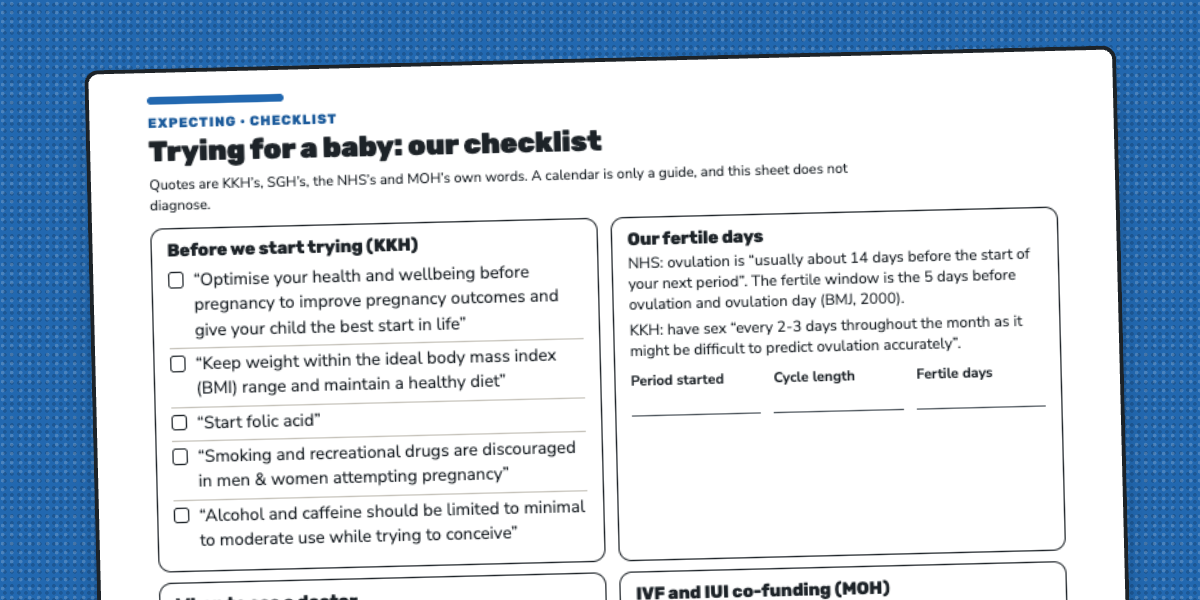
Trying for a baby checklist
One page for couples trying for a baby: KKH’s advice, your fertile days, when to see a doctor, and MOH co-funding for IVF and IUI.
See your own dates
Enter the first day of your last period and your usual cycle length. Your dates stay on your phone.
Find my fertile days → Print the checklist → Pregnant at 35 or older →Frequently asked questions
When is ovulation in a 28-day cycle?
About day 15, counting the first day of your period as day 1: 14 days before your next period, the NHS says.
How many fertile days are there in a cycle?
Six: the five days before ovulation and ovulation day itself, a BMJ study found. They move from cycle to cycle.
When should we see a doctor?
SGH says after a year of trying if you are under 35, or six months if you are over 35. KKH also lists women aged 35 and above.
Does the government pay for IVF?
At a public hospital, a Singapore Citizen couple can get 75% co-funding on a fresh cycle, capped at S$7,700. MediSave can pay part of the rest.
Keep this guide for the next big decision.
Build your own reading list and pick up where you left off with a free RaisingAngels account.
Free account · Tools stay free without an account.
Sources & assumptions
- NHS: Trying to get pregnant ↗
- NHS: Fertility in the menstrual cycle ↗
- Wilcox, Dunson and Baird, BMJ 2000: the timing of the fertile window ↗
- KKH KKIVF Centre: How can I improve my chances of pregnancy? ↗
- SGH: Infertility (SingHealth) ↗
- KKH KKIVF Centre: When should I seek help? ↗
- KKH: Fertility in women ↗
- Made For Families: Co-funding for assisted conception procedures ↗
- HealthHub (MOH): Debunking 5 myths of fertility health ↗
See a doctor if you are worried about your fertility.