Quick answer
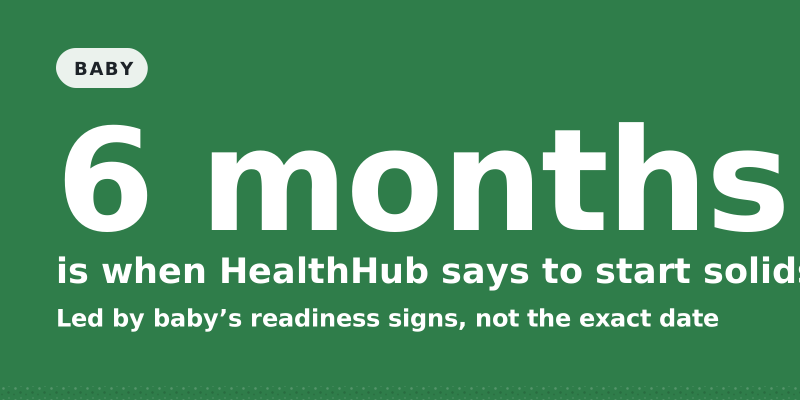
HealthHub (HPB) says to start solids after your baby is 6 months old, led by baby’s readiness signs. There is no need to start on the exact day. Begin with 1 to 2 teaspoons of a smooth food. Try a new food every 3 to 4 days. Milk feeds stay the main food through the first year.
The useful number: A baby born on 1 May 2026 reaches 6 months on 1 November 2026. Watch baby, not the calendar: the readiness signs decide the day.
When does your baby’s start window open?
Enter your baby’s date of birth.
Loading the official figures…
Who is this for?
Parents and carers of a baby coming up to 6 months. It sums up HealthHub’s page by the Health Promotion Board with KK Women’s and Children’s Hospital, and KKH’s advice on common allergens. Bring your questions to your baby’s next check-up.
How do you start solids?
- Note the day baby turns 6 months. The Starting solids planner works it out from the date of birth.
- Watch for the readiness signs below. Baby leads; the date is only a guide.
- Start with 1 to 2 teaspoons of a smooth food, such as iron-fortified rice cereal mixed with milk.
- Give one new food every 3 to 4 days. Watch for allergy signs after each one.
- Build up to 1 to 2 tablespoons, 2 to 3 times a day, with thicker purees as chewing improves.
- From 10 months, offer food that is mashed, chopped or cut into small pieces. Work up to three meals a day by about 10 to 12 months.
How do you know baby is ready?
HealthHub lists these signs:
- Sits up well against the back of a chair, holding the head up with some support
- Shows interest in food, such as watching or reaching for yours
- Opens the mouth for an incoming spoon and closes the lips around it
- Wants to chew and put things in the mouth
- Still seems hungry after milk feeds
Not ready yet if baby keeps pushing the spoon out with the tongue or has trouble swallowing. Wait a week and try again.
Which foods come first, and which wait?
Our example order, using only foods from HealthHub’s list. Skip or swap any of them:
- Grains
- Iron-fortified rice cereal mixed with milk
- Grains
- Rice porridge blended with pumpkin
- Grains
- Sweet potato
- Vegetables
- Carrot
- Fruit
- Banana
- Grains
- Oats
Steam, boil, bake or microwave, with no added oil, salt, sugar or seasonings such as soy sauce or chicken powder.
Leave these until after the first birthday:
- Honey
- Cow's milk as a drink before 12 months
- Uncooked food and unpasteurised dairy
- High-mercury fish: tuna, swordfish, shark, king mackerel, yellowback seabream
- Salty, preserved or processed food, and food seasoned with salt, soy sauce or chicken powder
- Sugary drinks and fruit juice
- Caffeinated drinks
Choking risks to avoid:
- Small, hard food such as whole nuts and raisins
- Crunchy raw vegetables
- Fish or meat with bones
- Fruit with seeds
- Sticky rice
When can baby try egg and peanut?
KKH’s Allergy Service says there is no need to delay common allergens such as egg or peanut. Early introduction may lower the risk of allergy to them.
For babies with a history of egg allergy and/or severe eczema, KKH says “a more proactive approach to introduce common allergens early may be justified”. Ask your doctor how to go about it. Offer egg fully cooked and peanut as a smooth paste, never whole nuts.
After each new food, watch for: hives, or eczema getting worse; swelling of the face, eyes, lips, tongue or mouth; watery stools; vomiting. See a doctor straight away if baby has any of them. For difficulty breathing or fainting, call 995.
What does this look like for a baby born on 1 May 2026?
The planner’s example plan, from the date of birth:
- 6 months old
- 1 November 2026
- First new food
- Iron-fortified rice cereal mixed with milk, 1 November 2026
- Second new food
- Rice porridge blended with pumpkin, 4 November 2026
- First common allergen
- Egg, fully cooked, 15 November 2026
- Mashed and chopped food from
- 1 March 2027
- First birthday
- 1 May 2027
Egg comes after the first 4 new foods, with no other new food in the same few days. If baby is not ready on the day, start later: the plan moves with you.
How much milk, age by age?
Tap an age to open it. Words in quotation marks are HealthHub’s.
Birth to 6 months
- Feed on demand, about every 2 to 3 hours, day and night.
- In the first 4 to 8 weeks, aim for at least 8 feeds in 24 hours.
- Expect more feeds for a few days during growth spurts, at about 2 to 6 weeks, 3 months and 6 months.
- A baby under 6 months who has only breast milk needs no extra water.
6 to 12 months
- “Milk will still be the main source of nutrition, in addition to solid foods in small portions”.
- HealthHub’s sample day at 7 months has 500 to 750 ml of milk.
- As baby eats more, a full meal of solids slowly replaces one milk feed.
- No cow’s milk as a drink before the first birthday.
From 1 year
- “Milk should still be a component of the toddler’s diet - with the toddler drinking between 400-500 ml per day”.
- “If the toddler is drinking a lot more than 500 ml per day, there may be concerns that he/she is not eating enough”.
- If your child no longer has breast milk, HealthHub says “he/she can switch to plain full-cream milk with a well-balanced diet”. Skip filled milk, condensed or evaporated milk, and flavoured milk.
- Move your toddler to an open cup, and then to a straw.
- HealthHub: breastfeed for at least 6 months, and up to 2 years if you can.
Worried baby is not getting enough? Ask your doctor or the hospital’s lactation consultants.
Which tool and download help?
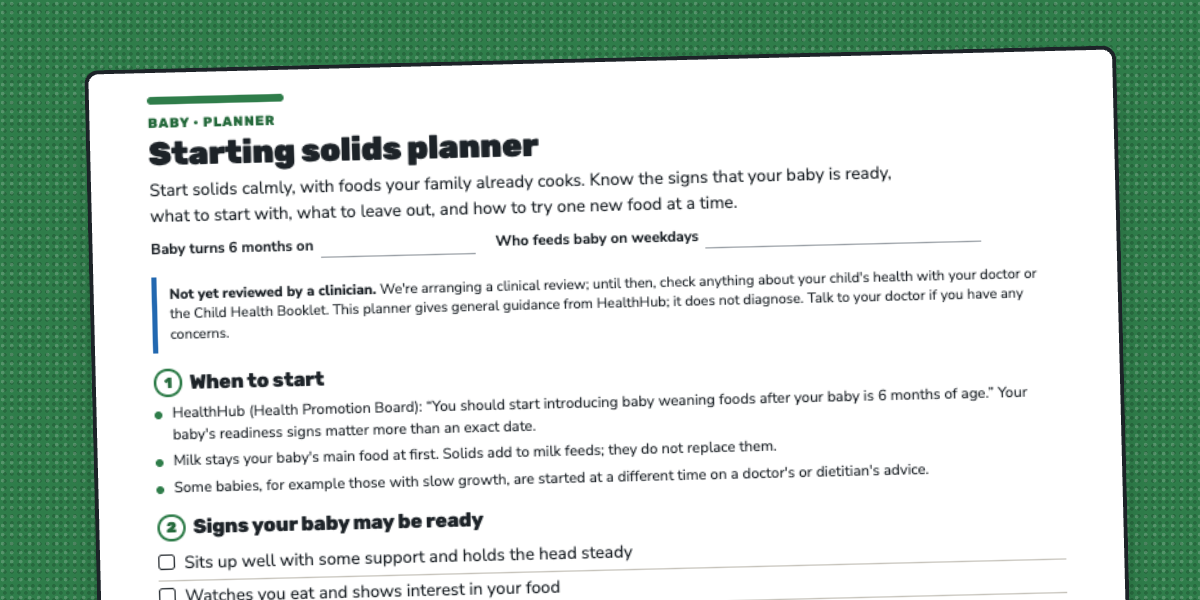
The Starting solids planner dates the start window and a week-by-week plan, and keeps a new-food and allergen log on this phone only. Print the Starting solids planner printable so every carer follows the same plan. What can I mention at my child’s next developmental check-up? helps you list questions for the next visit.
What does this guide not tell you?
It never decides whether a baby is ready or allergic. If baby was born early, has a medical condition or has trouble feeding, discuss it with your doctor before you start. Keep the Child Health Booklet for each visit.
Printables for this guide
Starting solids planner
HealthHub's timing after 6 months, readiness signs and local first foods like rice porridge and pumpkin. Includes a two-week tracker for every carer.
Frequently asked questions
Can baby start solids before 6 months?
HealthHub says to start after 6 months, led by readiness signs. If you think baby is ready earlier, discuss it with your doctor first.
How often should I give a new food?
Every 3 to 4 days, HealthHub says. Watch for allergy signs such as hives, swelling, watery stools or vomiting after each new food.
Should I wait before giving egg or peanut?
No, says KKH’s Allergy Service: there is no need to delay them. For babies with a history of egg allergy and/or severe eczema, KKH says introducing them early may be justified. Ask your doctor how.
How much milk does my toddler need?
HealthHub says 400 to 500 ml a day from 1 year. A lot more than 500 ml may mean your toddler is not eating enough.
Can baby have honey or cow’s milk?
Not before the first birthday. HealthHub lists honey, and cow’s milk as a drink, among the foods to avoid before 12 months.
Keep this guide for the next big decision.
Build your own reading list and pick up where you left off with a free RaisingAngels account.
Free account · Tools stay free without an account.